

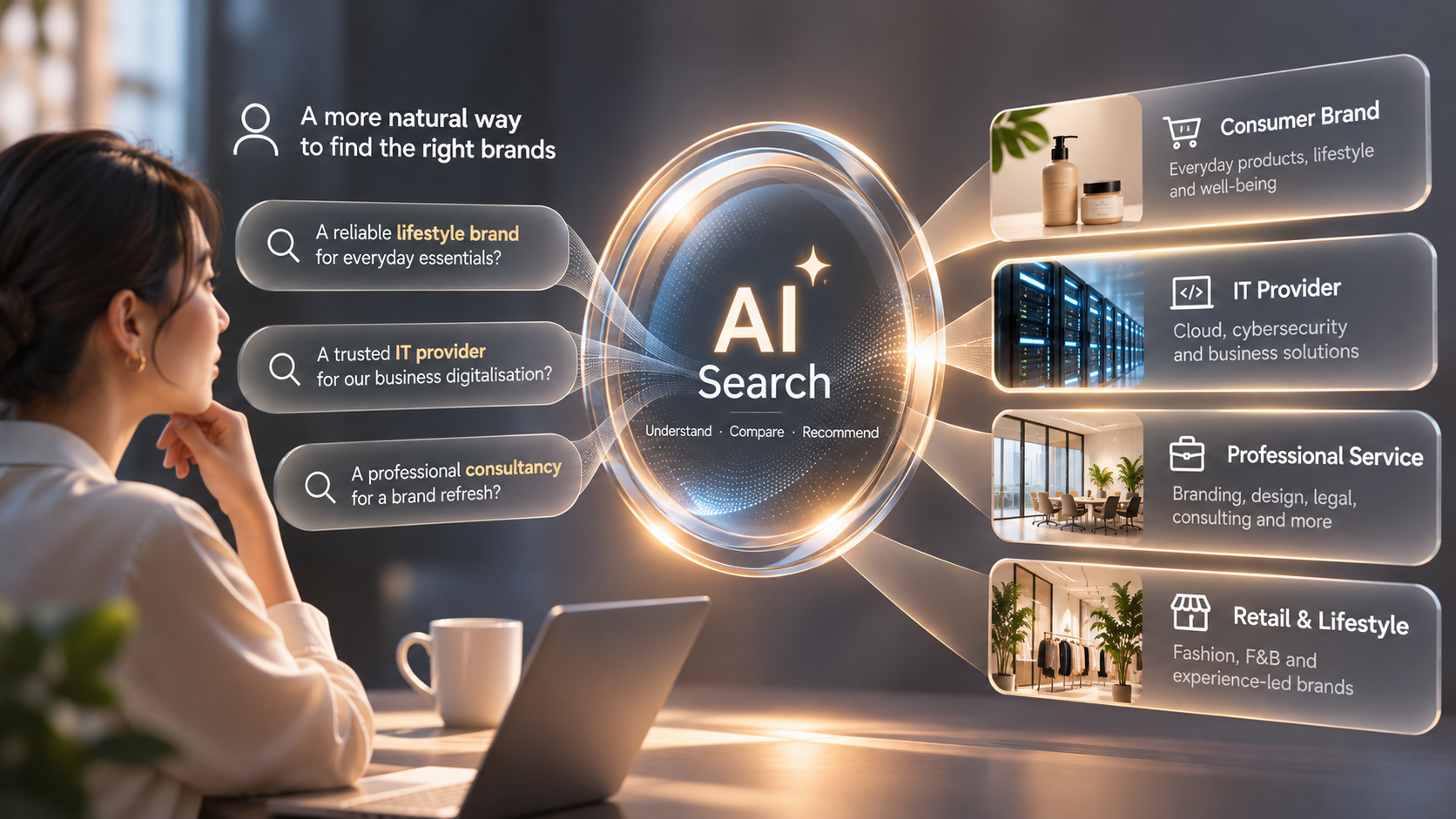
AI search brand discovery is changing how customers find, compare and evaluate businesses—often before they visit a company’s website.
Traditionally, a potential customer might search Google for a branding agency, browse several websites, compare portfolios and eventually contact a shortlist of providers.
Today, that same customer may begin with a question in ChatGPT, Google AI Mode or Microsoft Copilot:
“Which type of branding consultancy should a growing Singapore business engage?”
The customer may then ask follow-up questions about expertise, pricing, services, credibility and strategic fit.
AI-assisted search can help organise these considerations into an answer, potentially introducing companies and information the customer has not previously encountered.
For businesses, this represents a significant change in the discovery journey.
The challenge is no longer simply whether a company can be found online. It is whether prospective customers can understand what the company stands for, what makes it relevant and why it deserves consideration.
The central question is shifting from “Can customers find our business?” to “Can customers understand why our business is relevant to them?”
This article examines how AI search is reshaping brand discovery, what businesses should understand about this shift and why brand clarity, credibility and digital experience are becoming increasingly important.
What Is AI Search Brand Discovery?
AI search brand discovery describes how customers encounter, learn about and evaluate businesses through AI-assisted search experiences.
These experiences can include conversational questions, generated summaries, comparisons and references to information drawn from different sources.
For example, a business leader might ask:
- What is the difference between a branding agency and a creative agency?
- How do I choose a corporate branding consultancy in Singapore?
- What should a complete rebranding engagement include?
- How can a business evaluate the credibility of a design partner?
Rather than simply displaying a list of links, an AI search experience may help the user understand the available options and the considerations involved in making a decision.
A company may therefore become relevant to a prospective customer through the quality and specificity of its published information, not only through searches for its name.
However, inclusion in any particular AI-generated answer is not guaranteed. Different platforms use different methods, and responses may vary depending on the question and context.
How Is AI Search Different From Traditional Google Search?
Traditional search often helps customers find information. AI-assisted search can also help them interpret that information.
Both approaches remain important, and increasingly they overlap.
Consider a company looking for a corporate branding partner.
In a traditional search journey, the business might enter “branding agency Singapore”, open several results and compare the websites individually.
In an AI-assisted journey, the business might instead ask:
“We’re expanding from Singapore into Australia. Should we engage a branding agency, a web design agency or a strategic design consultancy?”
This question contains considerably more context.
The prospective customer is not merely looking for a list of suppliers. They are trying to understand which type of expertise is appropriate for a business situation.
That distinction changes how brands should think about their public information.
| Traditional search journey | AI-assisted search journey |
|---|---|
| Customer enters a keyword | Customer describes a business problem |
| Search results present relevant pages | AI may explain options and decision criteria |
| Customer visits websites to compare services | Some comparison may happen before the first visit |
| Companies compete for attention in results | Companies also need clearly understandable positioning |
| Website visits are central to discovery | Discovery may begin through conversational answers |
Google’s official guidance on AI features in Search explains how AI Overviews and AI Mode help people explore more complex questions while connecting them with relevant web content.
For businesses, the implication is important.
The quality of the information surrounding a brand becomes part of how that brand can be discovered and evaluated.
Why Does AI Search Make Brand Strategy More Important?
Because effective brand strategy answers precisely the questions customers ask when evaluating a business.
What does the company do?
Who does it serve?
What makes its approach distinctive?
What business problems can it address?
Why should a prospective customer trust it?
Consider two hypothetical design consultancies.
The first describes itself as a leading creative solutions provider delivering innovative and transformative experiences.
The second explains that it works with established and growing businesses to connect corporate positioning, brand identity, website experience and communication into a coherent business presence.
Both descriptions may sound professional.
But the second provides more useful information about the organisation’s role, scope and relevance.
The lesson is not that a company should simplify its identity to satisfy an algorithm.
It is that strong positioning should be sufficiently clear and specific to withstand questions, comparisons and closer scrutiny.
This is especially relevant for professional services, B2B companies and organisations whose capabilities cannot be understood through a simple product description.
As we explored in Why Branding Is a Strategic Business Asset, Not Just a Visual Identity, branding is fundamentally connected to how an organisation defines, expresses and communicates its business value.
AI-assisted discovery introduces another reason to take that clarity seriously.
For leadership teams reviewing their positioning, the starting point should be a question of business identity—not simply a question of search rankings.
How Do Customers Discover Brands Through AI Search?
A useful way to understand the process is through three stages: discovery, evaluation and validation.
1. Discovery: What Options Exist?
The prospective customer begins by exploring a problem.
They may not know which type of company they need.
For example:
“Our company has expanded into several markets, but our brand hasn’t changed. Do we need to rebrand?”
Or:
“Why does our corporate website no longer reflect the scale of our business?”
At this point, useful information helps the buyer understand the problem and its possible solutions.
A company that explains these issues thoughtfully may establish an initial connection with a prospective customer.
The objective is not necessarily an immediate enquiry.
It is to become relevant within the customer’s understanding of the problem.
2. Evaluation: Which Approach Is Appropriate?
Once the problem becomes clearer, the questions become more specific.
“Should we develop brand strategy before redesigning the website?”
“Can one consultancy manage both corporate identity and digital experience?”
“What deliverables should we expect from a corporate branding project?”
The customer is now examining alternatives.
Content that explains strategic considerations, engagement scopes, processes and trade-offs can help them make a more informed decision.
This is particularly valuable for premium services, where buyers are rarely selecting a provider solely on price.
3. Validation: Can This Company Be Trusted?
Before contacting a company, the buyer may look for evidence that supports its claims.
Does the organisation demonstrate relevant expertise?
Is its service offering clearly explained?
Does its website communicate a consistent professional identity?
Are its project examples, experience and published insights credible?
Does the company appear to understand the business problem?
At this stage, the brand experience becomes more than a visual impression. It becomes part of how the customer forms confidence in the organisation.
Discovery creates awareness. Evaluation creates understanding. Validation creates confidence.
A strong brand should support all three stages.
What Makes a Brand Easier to Discover and Understand?
The answer is not simply producing more content.
Publishing dozens of articles does little to strengthen a brand if they repeat generic observations, contradict the organisation’s positioning or fail to address the decisions its customers are making.
A more useful approach is to examine whether the organisation communicates its value consistently across the entire discovery journey.
At Byràv Designs, we find it useful to consider five connected dimensions through a practical framework: CLEAR—Clarity, Legibility, Evidence, Alignment and Relevance.
This is a brand assessment framework, not a search-ranking formula or a guarantee of AI recommendations.
C — Clarity: Can Someone Understand What Your Business Does?
An organisation should be able to explain its purpose, capabilities and distinctive proposition without relying on vague promotional language.
For example, “we deliver innovative end-to-end solutions” communicates very little about the organisation.
A clearer explanation identifies the business challenges it addresses, the customers it serves and how its capabilities contribute to a particular outcome.
For a corporate branding consultancy, this may involve distinguishing brand strategy, visual identity, digital experience and corporate communications.
Each discipline serves a different purpose, but the disciplines should form a coherent proposition.
A useful question: Could an unfamiliar business leader explain what your company does after reading your homepage?
If not, the problem may be deeper than website copy.
It may be a positioning issue.
L — Legibility: Is Your Expertise Easy to Find and Understand?
A website should make essential business information accessible to visitors.
This includes meaningful headings, logical navigation, clear service descriptions and readable explanations.
A visually sophisticated website can still be difficult to understand if its most important information is hidden behind vague headlines, unnecessarily complex navigation or content that cannot be easily accessed.
Search systems also rely on technical and structural signals to discover and interpret web content.
Google’s AI search documentation emphasises that established search fundamentals—including crawlability, accessible content and internal linking—remain relevant to its AI features.
This does not mean design should become formulaic.
It means the visual experience and information architecture should work together.
A useful question: Can a customer quickly find a clear explanation of your services, expertise and value?
E — Evidence: What Supports Your Brand’s Claims?
Premium positioning cannot depend entirely on calling a business premium.
Credibility needs substance.
A professional services organisation may demonstrate expertise through its methodology, leadership experience, carefully documented work, independent credentials or substantive insights.
A design consultancy may explain why a particular brand decision was appropriate, how different business requirements were reconciled or what strategic considerations informed a creative direction.
A technology company may explain implementation considerations, technical capabilities or the operational problems its solution addresses.
Not every business can publicly disclose client engagements.
Where confidentiality applies, organisations can still communicate the reasoning behind their approach without manufacturing testimonials or unsupported claims.
A useful question: What credible evidence can a prospective customer examine before deciding to contact you?
The objective is to make expertise understandable rather than simply asserted.
A — Alignment: Does Your Brand Communicate Consistently?
Inconsistent corporate communication can weaken trust.
A company may describe itself as a strategic consultancy on its homepage but appear as a general production agency on its service pages.
Its corporate presentation may emphasise different capabilities from its website.
Its external profiles may describe services it no longer offers.
These inconsistencies make it harder for customers to establish a coherent picture of the organisation.
The brand does not need to communicate with identical wording everywhere.
It does, however, need a consistent underlying identity.
Corporate positioning, visual identity, website experience, packaging and business communication should reinforce one another.
A useful question: Would a prospective customer recognise the same organisation across your website, corporate presentation, proposals and other touchpoints?
R — Relevance: Are You Answering Questions That Matter to Your Customers?
Many organisations publish content without clearly considering the customer’s decision-making process.
A prospective client evaluating corporate branding may not need another basic definition of a logo.
They may want to understand the distinction between strategy and identity, how to evaluate different consultancies, what a complete engagement includes and how to determine whether the investment is appropriate.
These questions are closer to the real business decision.
Relevant content should help the customer progress from recognising a problem to understanding appropriate options.
A useful question: Does your content help a potential customer make a better business decision?
Bringing the CLEAR Framework Together
| Dimension | What it helps establish |
|---|---|
| Clarity | Understanding of the organisation |
| Legibility | Accessibility of its expertise |
| Evidence | Credibility of its claims |
| Alignment | Consistency across touchpoints |
| Relevance | Fit with the customer’s needs |
The five dimensions are connected.
A technically accessible website with weak positioning remains difficult to differentiate.
Strong positioning without credible evidence may be unconvincing.
A distinctive identity without clear communication can fail to explain the company’s actual capabilities.
Effective brand discovery is therefore not simply a visibility challenge. It is a question of organisational coherence.
Does AI Search Make Corporate Website Design More Important?
Yes, but not because every website needs to be redesigned for AI.
A company’s website remains one of its most important opportunities to explain its business in depth.
Even when a prospective customer encounters the organisation through an AI-generated answer, they may still visit the website to examine its capabilities, understand its approach and determine whether to initiate contact.
At that point, the digital experience must support the expectations created during discovery.
A credible corporate website should communicate the organisation’s positioning clearly, explain its services, establish a consistent identity, provide relevant supporting information and make further engagement straightforward.
It should also work reliably across devices and remain practical to maintain.
A visually attractive website that fails to explain the business may create interest without generating understanding.
An information-heavy website without coherent design may communicate technical facts without establishing confidence.
The strongest digital experiences connect both.
For organisations evaluating website investment, our guide to Website Design Cost in Singapore discusses why strategic scope and business value matter more than the number of pages or visual features alone.
Can Premium Brand Design Improve AI Search Visibility?
Premium brand design can improve human perception, recognition and the clarity of communication.
But there is no reliable basis for claiming that sophisticated visual design automatically causes an AI system to recommend a company.
The relationship is more nuanced.
A clear corporate identity can reinforce recognition.
Thoughtful information design can make complex expertise easier to understand.
Consistent messaging can strengthen the organisation’s positioning.
A well-structured website can improve access to useful information.
Together, these elements can create a more coherent experience for customers.
However, different AI search systems use their own methods to discover, evaluate and reference sources.
Strong design supports the credibility and usability of a brand. It should not be presented as an algorithmic shortcut.
The objective is to build a business presence that remains credible across changing discovery environments.
How Should Singapore Businesses Prepare for AI-Assisted Brand Discovery?
Businesses do not necessarily need to begin with a new technology platform or a complete website redevelopment.
A more productive starting point is to examine whether their current brand adequately represents the organisation.
First, Review Your Brand Positioning
Does the business clearly explain its capabilities, intended audience and distinctive value?
If its positioning relies on broad descriptions that could apply to almost any competitor, further strategic refinement may be necessary.
Second, Examine Your Core Service Pages
Each important service should explain the business need it addresses, what the engagement involves and how the service connects to the organisation’s wider capabilities.
This becomes particularly important when several disciplines overlap.
Third, Strengthen Evidence of Expertise
Review whether the website provides credible information that supports the organisation’s claims.
This may involve relevant experience, thoughtful perspectives, methodologies, documented work or independently verifiable information.
Avoid fabricated rankings, unsupported superiority claims and generic statements of expertise.
Fourth, Align Corporate Communications
The company profile, website, business presentations and external descriptions should communicate a consistent identity.
An organisation’s positioning should not change dramatically from one touchpoint to another.
Fifth, Ensure Important Information Is Accessible
Technical foundations matter.
Google provides official documentation explaining how its AI search features work with established search requirements.
OpenAI also publishes guidance on web crawlers used by OpenAI products, including OAI-SearchBot, which supports search-related discovery.
Microsoft provides Bing Webmaster Guidelines covering important principles for web discovery and indexing.
These resources can guide technical reviews of publicly accessible website content.
However, meeting technical requirements does not guarantee visibility in AI-generated answers.
For business leaders, the priority remains clear and credible communication. Technical implementation should support that objective.
If your organisation has grown or changed significantly, this is also an appropriate time to evaluate whether your brand identity and digital presence still reflect the business you have become.
How Can Businesses Measure Brand Visibility in AI Search?
Measuring AI-assisted discovery is more complicated than counting website visitors.
A company may be mentioned in an AI-generated response without receiving a click.
A prospective customer may also use several sources before deciding to contact the business, making it difficult to attribute an enquiry to one particular platform.
A balanced assessment should therefore consider several indicators.
| Indicator | What it helps evaluate |
|---|---|
| Branded search queries | Whether customers are actively looking for the company |
| Non-branded search impressions | Whether the business is appearing for relevant questions |
| Search clicks | Whether search exposure is generating website visits |
| Website engagement | Whether visitors explore useful information |
| AI citations or mentions | Whether selected systems reference the company |
| Qualified enquiries | Whether visibility contributes to relevant business conversations |
Google Search Console and website analytics can support parts of this assessment.
AI search tools may offer different levels of reporting, and some discovery activity may remain unobservable.
It is therefore important not to confuse a single AI mention with proven commercial impact.
Likewise, an increase in website impressions does not automatically indicate improved brand perception or qualified lead generation.
The more valuable question is whether the organisation is becoming easier for the right customers to discover, understand and evaluate.
What Does AI Search Mean for Premium Brands?
Premium brands face a distinctive challenge.
Their value is often based on expertise, judgement, originality, strategic thinking and the ability to address complex requirements.
These qualities are difficult to communicate through simplistic comparisons.
A premium consultancy should therefore avoid responding to AI search by adopting generic language, publishing large volumes of superficial content or competing primarily on price.
Instead, it should make the substance of its expertise more visible.
For example, a design consultancy can explain how business positioning informs identity development.
It can explore why a website should support the organisation’s communication strategy rather than function merely as a visual presentation.
It can clarify when a brand refresh is sufficient and when a deeper strategic rebranding exercise may be warranted.
It can also explain the relationship between corporate identity, packaging, product expression and stakeholder communications.
This type of content helps buyers understand the reasoning behind a service.
It also gives the organisation opportunities to demonstrate its particular perspective.
The objective is not to make the brand louder. It is to make the brand more understandable without making it less distinctive.
When assessing potential partners, businesses may also find our guide to Choosing a Branding Agency in Singapore useful for understanding the role of strategic fit, expertise and long-term alignment.
Byràv Designs: Building Brands That Remain Relevant as Discovery Evolves
At Byràv Designs, we believe strong branding begins with understanding the business behind the identity.
Our approach connects four complementary disciplines.
Brand Strategy & Identity establishes how the organisation should be positioned, understood and recognised.
Digital Brand Experiences translate that identity into coherent, credible and engaging digital interactions.
Packaging & Product Branding extend the brand’s expression into physical products and customer encounters.
Corporate Communications & Design maintain consistency across business stakeholders, presentations and other communication touchpoints.
These areas are closely connected.
A business should not require one identity for its website, another for its corporate presentation and a third for its external communications.
The different expressions of the brand should reinforce the same underlying business proposition.
This becomes particularly important as organisations expand, diversify or enter new markets.
Their capabilities evolve. Their customers change. Their competitive environments become more complex.
The brand needs sufficient clarity and consistency to grow alongside the business.
AI-assisted discovery is another development in that journey.
It changes how some prospective customers may initially encounter a company, but it does not replace the fundamental importance of strategic positioning and credible communication.
Brands that are strategically clear, consistently expressed and supported by credible substance are better positioned to earn trust—regardless of where the customer journey begins.
Frequently Asked Questions About AI Search and Brand Discovery
What is AI search brand discovery?
AI search brand discovery refers to how prospective customers encounter, research and evaluate businesses through AI-assisted search systems. This may include conversational questions, generated summaries, comparisons and references to external sources.
How is AI search changing customer behaviour?
AI-assisted search allows customers to explore complex questions and compare alternatives conversationally. Some early evaluation may happen before the customer visits an individual company’s website.
Will AI search replace Google Search?
Traditional search and AI-assisted experiences continue to coexist. Google itself incorporates AI features into its search platform. Different customers will continue to use different discovery methods depending on their needs.
How can a company become more visible in AI-generated answers?
There is no guaranteed approach. Clear positioning, accurate and useful information, a technically accessible website and credible evidence of expertise can strengthen a company’s overall digital presence. Inclusion still depends on the relevant platform.
Does brand strategy influence AI search visibility?
Brand strategy helps define an organisation’s positioning, audience, distinctive capabilities and communication principles. These foundations can make the business easier to understand and evaluate, although they do not guarantee specific search outcomes.
Does a premium website improve AI search rankings?
Not automatically. The value of a premium website lies in how effectively it combines brand identity, useful information, accessibility, usability and credible communication. Visual sophistication alone does not guarantee rankings or AI recommendations.
Can a smaller business compete with established brands in AI search?
Smaller businesses may have opportunities when they offer relevant expertise, a distinctive perspective and clearly explained capabilities. However, publishing content more frequently or adopting AI-related terminology does not guarantee greater visibility.
Is AI search optimisation the same as corporate branding?
No. AI search optimisation focuses on discoverability within AI-assisted systems. Corporate branding addresses the organisation’s identity, positioning, perception and experience. They can support one another, but they serve different purposes.
How should businesses measure AI search performance?
Businesses can examine branded search activity, non-branded search impressions, identifiable AI referrals, citations where observable, website engagement and qualified enquiries. Because attribution is incomplete, the indicators should be assessed together.
The Future of Brand Discovery Starts With Brand Clarity
AI search is changing how prospective customers explore business problems, compare organisations and form initial impressions.
Yet the most important questions remain familiar.
What does the organisation stand for?
Why should customers trust it?
What makes its capabilities distinctive?
Can it communicate its value clearly and consistently?
Technology may change how these questions are asked and answered.
It does not eliminate the need for a coherent brand.
For business leaders, this creates an opportunity to examine whether their corporate identity, digital experience and communication accurately represent the business they have built—and the direction in which it is growing.
The brands best prepared for evolving discovery will not necessarily be those producing the most content. They will be those able to communicate meaningful value with clarity, credibility and consistency.
Considering how your brand should evolve?
Byràv Designs works with organisations seeking a more coherent connection between business positioning, identity, digital experience and corporate communication.