


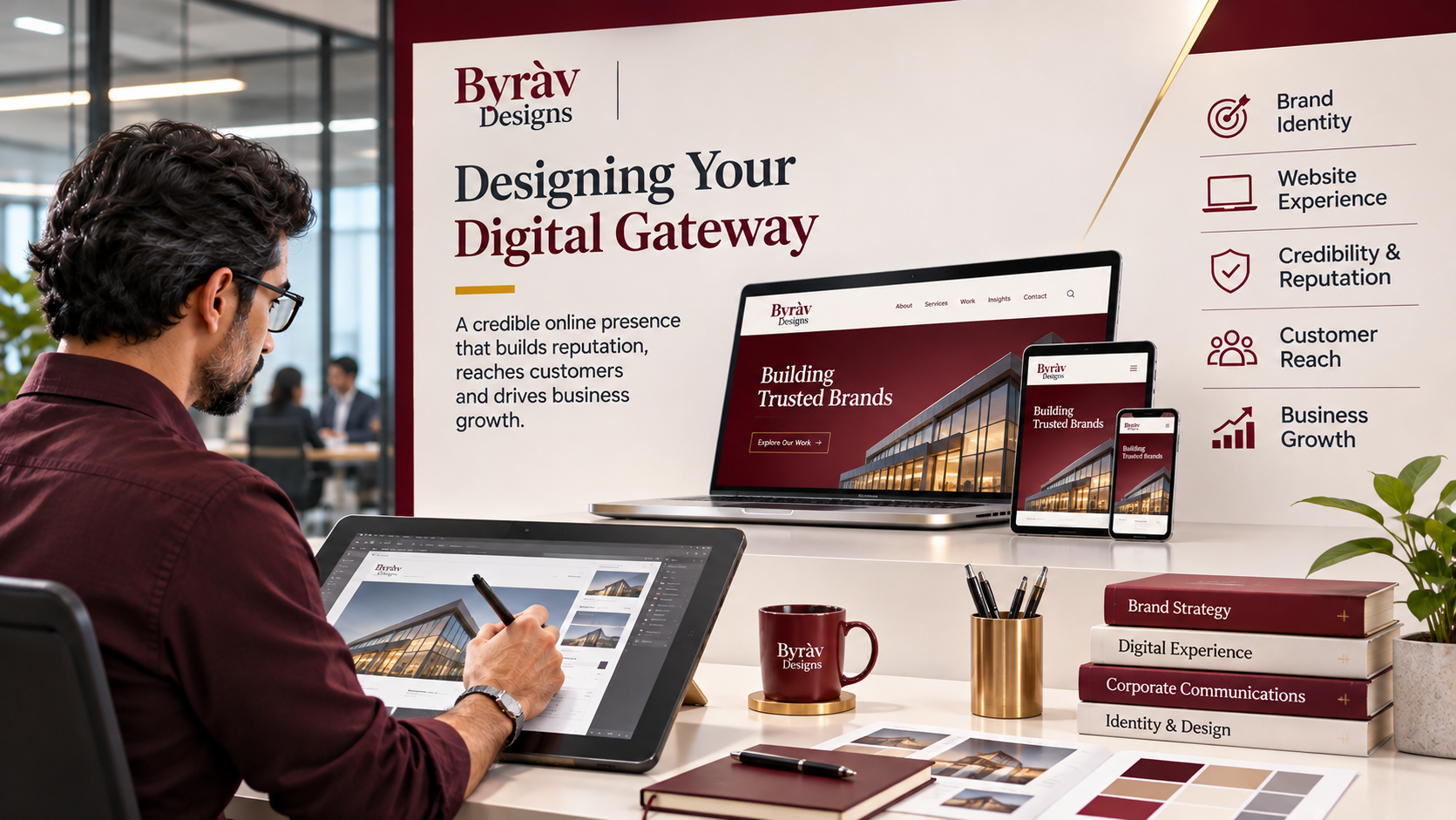
A trustworthy corporate website does more than look professional. It clearly explains the business, demonstrates credible expertise, communicates consistently and gives prospective customers the confidence to take the next step.
For many organisations, the website is the first substantial interaction a potential customer has with the company.
Before arranging a meeting, requesting a proposal or evaluating a long-term partnership, a business decision-maker may examine the company’s website to understand its capabilities, experience and relevance.
That first interaction carries considerable responsibility.
A beautifully designed website can create an immediate impression. But if it provides little useful information, relies on generic claims or makes the organisation difficult to evaluate, that impression may not translate into trust.
Similarly, a company may have strong technical capabilities, experienced leadership and an established reputation, yet communicate those qualities poorly through an outdated digital presence.
The challenge is not simply to make a corporate website attractive. It is to make the organisation behind it credible, understandable and worth considering.
For businesses evaluating corporate website design in Singapore, this distinction is particularly important. Customers, partners and investors may encounter the organisation digitally long before meeting its representatives.
So what makes a corporate website trustworthy, and how can businesses assess whether their current website communicates the right level of confidence?
Why Does Corporate Website Credibility Matter?
Corporate website credibility refers to the degree to which visitors perceive a company’s online presence as believable, professional, transparent and reliable.
It is not determined by any single design feature.
Instead, credibility develops through the combination of visual presentation, useful information, evidence, transparency, technical reliability and the overall visitor experience.
A corporate website may need to establish confidence among several audiences simultaneously.
A prospective customer wants to know whether the business can solve a particular problem.
A potential partner may want to understand the organisation’s capabilities and reliability.
An investor may be interested in the company’s positioning, leadership and business direction.
A prospective employee may want to understand the culture and professional identity of the organisation.
Each audience approaches the website with different questions.
Yet all are looking for a consistent underlying answer:
Is this an organisation I can understand and trust?
Stanford University’s foundational Web Credibility Guidelines emphasise principles such as making information verifiable, demonstrating that a real organisation exists and presenting professional, usable content.
Although these guidelines emerged from earlier web credibility research, their underlying principles remain relevant to how businesses communicate credibility today.
The lesson for corporate website design is straightforward: visual quality matters, but it cannot substitute for substance.
What Are the Nine Signs of a Trustworthy Corporate Website?
A trustworthy corporate website should perform nine interconnected functions.
It needs to establish clear positioning, communicate a coherent visual identity, provide evidence of expertise, demonstrate organisational transparency, maintain consistency, support intuitive navigation, perform reliably, answer meaningful questions and offer clear next steps.
These qualities are particularly important for professional services, B2B organisations and businesses operating in competitive or complex markets.
1. Clear Business Positioning: Can Visitors Immediately Understand the Company?
The first credibility signal is clarity.
When someone arrives on a corporate website, they should be able to understand what the organisation does, whom it serves and why its capabilities are relevant.
This sounds simple, yet many corporate websites rely on broad statements that could apply to almost any business.
Consider a homepage that says:
“Empowering tomorrow through innovative, world-class solutions.”
The statement may sound ambitious, but it provides little useful information.
What does the organisation actually offer?
Which business problems does it address?
Who is its intended customer?
A clearer proposition explains the business in specific terms.
For example, a technology consultancy might describe how it supports enterprises with system integration, infrastructure modernisation and operational transformation.
A corporate design consultancy might explain how it connects brand positioning, identity and digital experience for established and growing businesses.
Clarity does not require reducing a sophisticated organisation to a simplistic slogan.
It requires establishing a meaningful hierarchy of information.
What to evaluate:
- Does the homepage communicate the company’s core capabilities?
- Is the intended audience apparent?
- Can visitors distinguish the business from credible alternatives?
- Do the main service pages reinforce the same proposition?
If an organisation struggles to explain what it does on its own website, prospective customers may struggle to understand why they should engage it.
This is fundamentally a brand strategy issue, not merely a copywriting problem.
For additional context, explore Why Branding Is a Strategic Business Asset, Not Just a Visual Identity.
2. Professional Visual Identity: Does the Website Reflect the Organisation’s Quality?
Visual design shapes the initial perception of a business.
Typography, colour, spacing, imagery, composition and consistency all contribute to how a corporate website feels.
However, professional design should not be confused with excessive visual decoration.
A website may include elaborate animations, dramatic transitions and striking graphics while making the organisation difficult to understand.
Equally, a restrained website can communicate considerable sophistication when its typography, imagery, layout and information hierarchy have been thoughtfully developed.
For a premium organisation, the objective should be visual confidence rather than visual noise.
A coherent design system helps establish recognition.
Consistent typography creates hierarchy.
Appropriate imagery reinforces positioning.
Thoughtful spacing improves readability.
A disciplined layout makes the company’s information easier to navigate.
The design should feel intentional.
Nielsen Norman Group’s research on Trustworthiness in Web Design identifies design quality among the factors that influence perceived credibility, alongside transparency and the completeness of information.
What to evaluate:
- Does the website communicate a consistent visual identity?
- Is the design appropriate for the organisation’s market position?
- Are images relevant and credible?
- Does the interface feel considered rather than assembled from unrelated templates?
- Does the visual experience support the information being communicated?
A premium website should not simply look expensive.
It should make the business feel coherent, capable and professionally represented.
3. Evidence of Expertise: Can the Organisation Substantiate Its Claims?
Many corporate websites describe their organisations as experienced, trusted, innovative or industry-leading.
Such claims are common.
What differentiates a credible organisation is the evidence supporting them.
For professional services, this may include relevant experience, carefully documented engagements, leadership credentials, technical qualifications or a clearly explained methodology.
For a technology company, it may involve implementation capabilities, technical expertise, partnerships or relevant project experience.
For a design consultancy, it may involve selected work demonstrating the connection between a business challenge and a considered design response.
Importantly, evidence does not always need to be expressed through numbers or client logos.
Some organisations operate under confidentiality agreements and cannot disclose detailed project information.
In those situations, expertise can still be communicated through thoughtful perspectives, anonymised examples, process explanations and independently verifiable credentials.
The distinction is between demonstrating understanding and merely claiming superiority.
A corporate website should avoid fabricated testimonials, unsubstantiated rankings and exaggerated statements of capability.
What to evaluate:
- Are important claims supported by credible information?
- Is relevant expertise visible?
- Does the website explain how the organisation approaches complex problems?
- Can visitors independently verify important credentials or references?
- Are examples accurate and appropriately presented?
Credibility becomes stronger when a company provides sufficient substance for customers to make their own assessment.
4. Organisational Transparency: Is There a Real Business Behind the Website?
A corporate website should make it clear who is responsible for the organisation and how prospective customers can engage with it.
Transparency is especially important when the company offers services requiring substantial commitment, financial investment or long-term collaboration.
A website with polished marketing language but no meaningful organisational information can create unnecessary doubt.
Visitors may reasonably want to understand the company’s location, professional background, business activities and communication channels.
Depending on the organisation, relevant information might include an About page, leadership or team information, corporate contact details, office locations and appropriate legal disclosures.
Not every company needs to publish extensive personal information.
The objective is to provide appropriate institutional transparency while respecting privacy and security.
What to evaluate:
- Is the organisation clearly identified?
- Are its contact details accessible?
- Does the About page provide meaningful information?
- Are important legal or corporate details presented where relevant?
- Can customers understand who they are engaging with?
Stanford’s credibility guidance explicitly highlights the importance of demonstrating that a genuine organisation stands behind a website.
For businesses establishing relationships across borders, this can be an especially important confidence signal.
5. Consistent Brand Communication: Does Every Page Tell the Same Story?
A trustworthy corporate website should communicate a consistent business identity across its pages.
Inconsistency can take many forms.
The homepage may describe the organisation as a strategic consultancy, while service pages present it as a generic production agency.
One section may emphasise premium expertise while another uses heavily promotional language.
The visual identity may change unexpectedly between pages.
A company may also retain descriptions of services it no longer provides.
These inconsistencies do not always indicate poor business capabilities. But they can make the organisation harder to evaluate.
Corporate communication should reflect a clear underlying positioning.
This does not mean every page must sound identical.
Different pages serve different purposes.
A service page may explain scope and capabilities.
An About page may communicate organisational character.
A perspective article may demonstrate the company’s thinking.
A contact page may invite a business conversation.
The language can adapt to each purpose while remaining recognisably part of the same organisation.
What to evaluate:
- Do the homepage and service pages reinforce the same positioning?
- Is the corporate identity consistently applied?
- Does the language reflect the organisation’s intended market position?
- Are outdated offerings or contradictory descriptions still present?
- Does the website feel like one coherent business?
Consistency is particularly important for organisations that have expanded or evolved beyond their original identity.
A website should represent the business as it exists today, not merely preserve the business it was when the site was first created.
6. Intuitive User Experience: Can Visitors Find What They Need?
A corporate website is not only a presentation of information.
It is an experience through which visitors explore an organisation and assess its suitability.
When navigation is confusing, users may struggle to understand the company’s offering.
When important information is buried beneath multiple layers of menus, the website creates unnecessary effort.
When every page is overloaded with competing calls to action, the visitor may find it difficult to identify the next logical step.
A useful corporate website should provide a clear information hierarchy.
Its navigation should reflect how visitors understand the business.
Its service pages should explain offerings in meaningful categories.
Its content should connect related questions naturally.
For example, a potential client researching corporate website design may want to understand the difference between design and development, the role of brand strategy, how a project is scoped and what should be considered before selecting a consultancy.
A thoughtfully structured website enables that journey.
It does not require the visitor to discover every answer through trial and error.
What to evaluate:
- Can visitors find relevant services without confusion?
- Are important pages accessible through intuitive navigation?
- Does the website organise information around the customer’s needs?
- Are there logical connections between related pages?
- Is the experience equally understandable on desktop and mobile?
Good user experience should reduce unnecessary effort.
For complex professional services, it should also help customers make sense of complex information.
7. Technical Reliability: Is the Website Secure, Accessible and Dependable?
Trust can deteriorate quickly when a website fails to function reliably.
Slow loading, broken links, inaccessible information, unexpected errors and poorly adapted mobile layouts can create an impression of neglect.
Technical quality does not necessarily demonstrate that a company is commercially reliable.
However, visible technical problems can weaken confidence in an otherwise professional organisation.
Several fundamentals deserve attention.
Secure connections: Websites should use HTTPS appropriately and manage visitor information responsibly.
Mobile responsiveness: Content should remain usable across common devices and screen sizes.
Performance: Pages should load efficiently without unnecessary delays or disruptive visual movement.
Accessibility: Content should be designed to accommodate people with different abilities and interaction needs.
Functional reliability: Navigation, forms, documents and other important features should work consistently.
The World Wide Web Consortium provides the Web Content Accessibility Guidelines (WCAG), an internationally recognised framework for making web content more accessible.
Accessibility should not be treated as a decorative feature or an optional afterthought.
It is part of making a digital experience usable for a broader audience.
What to evaluate:
- Does the website perform reliably across devices?
- Are navigation and enquiry forms functioning properly?
- Is the content readable and accessible?
- Are there obvious broken pages or outdated links?
- Does the site handle important user information appropriately?
A professionally managed corporate website should demonstrate the same attention to detail that customers expect from the organisation itself.
8. Meaningful Content: Does the Website Help Buyers Make Decisions?
Corporate websites often describe what a company offers without addressing the questions that matter most to its prospective customers.
A trustworthy website should do both.
For example, a business considering a website redesign may want to know:
“Should we update the website or revisit our brand positioning first?”
“What distinguishes a corporate website from a basic business website?”
“What should be included in a complete website design engagement?”
“How do we evaluate the quality of a proposed digital experience?”
These questions indicate genuine business concerns.
A useful website addresses them clearly.
It explains the context behind a service, the considerations involved in a decision and the circumstances in which different approaches may be appropriate.
This does not mean every page needs to be lengthy.
A concise explanation may be more useful than an elaborate article when the question is straightforward.
The important principle is relevance.
Content should help people understand a business decision rather than simply repeat broad promotional claims.
This also becomes relevant as more customers use AI-assisted search experiences to explore suppliers and compare options.
As discussed in our previous article, How Is AI Search Changing Brand Discovery?, prospective buyers may begin evaluating an organisation before visiting its website.
The website then becomes an important place to validate the information they have encountered.
What to evaluate:
- Does the website answer important customer questions?
- Does it explain the reasoning behind the company’s approach?
- Is the content specific to the organisation’s actual expertise?
- Are claims accurate and current?
- Does the content support different stages of the buying journey?
Useful content should reduce uncertainty.
For premium businesses, this is more valuable than publishing material solely to increase page count.
9. Clear Next Steps: Can Customers Engage Without Unnecessary Friction?
A corporate website should make it easy for an interested customer to initiate an appropriate conversation.
However, a clear call to action does not need to be aggressive.
Premium services often involve careful evaluation, internal discussions and multiple stakeholders.
A prospective customer may not be ready to request a quotation immediately.
They may first want to understand the organisation’s capabilities, examine its approach or clarify whether a potential engagement is appropriate.
The website should support this process.
Contact information should be accessible.
Enquiry forms should request only necessary details.
Service pages should provide sufficient context before asking visitors to take action.
Calls to action should reflect the nature of the business relationship.
For example, a strategic consultancy may benefit more from inviting a discussion about the organisation’s requirements than from promising an instant solution.
What to evaluate:
- Is it clear how to contact the business?
- Does the enquiry process feel straightforward?
- Are visitors asked for more information than necessary?
- Do calls to action match the company’s professional positioning?
- Can customers determine an appropriate next step?
The purpose of a credible corporate website is not to pressure every visitor into an immediate enquiry.
It is to make meaningful engagement easier when the customer is ready.
How Can Businesses Evaluate Their Own Corporate Website?
A useful assessment should go beyond visual preferences.
Leadership teams often evaluate websites through questions such as whether the design looks contemporary or whether the company logo is sufficiently prominent.
These considerations have a place, but they do not necessarily reveal whether the website supports the business effectively.
A more balanced approach examines the visitor’s journey.
At Byràv Designs, we consider four connected stages through the Corporate Website Confidence Framework.
Stage 1: Recognition — Does the Website Establish a Professional Identity?
The visitor encounters the organisation for the first time.
The website should create a coherent impression through positioning, visual identity, tone and overall presentation.
The key question is whether the company appears distinctive and professionally represented.
Stage 2: Understanding — Can the Visitor Explain What the Company Offers?
The visitor begins exploring the website.
Service descriptions, navigation and messaging should explain the organisation’s capabilities and relevance.
The key question is whether the business becomes easier to understand as the visitor explores.
Stage 3: Validation — Can the Visitor Substantiate the Company’s Claims?
The visitor evaluates credibility.
Evidence, transparency, expertise and meaningful content should support the organisation’s proposition.
The key question is whether the information provides a reasonable basis for confidence.
Stage 4: Confidence — Is the Visitor Ready to Consider Engagement?
The visitor considers the next step.
A coherent experience, clear communication and accessible contact options should support informed decision-making.
The key question is whether the website has reduced enough uncertainty for a relevant business conversation to become worthwhile.
The Corporate Website Confidence Framework
| Stage | Visitor’s question | Website responsibility |
|---|---|---|
| Recognition | Who is this organisation? | Establish identity and positioning |
| Understanding | What does it actually do? | Explain capabilities and relevance |
| Validation | Why should I believe its claims? | Demonstrate credibility and substance |
| Confidence | Should I take the next step? | Support informed engagement |
This framework is a practical assessment model developed for Byràv’s editorial perspective, not a scientifically validated website scoring system.
Its value lies in encouraging businesses to assess their websites from the perspective of the people evaluating them.
A corporate website is effective when its visitors become progressively more confident in their understanding of the organisation.
Does a Premium-Looking Website Automatically Build Trust?
No.
A premium-looking website can create a favourable initial impression, but lasting confidence requires supporting information and a coherent user experience.
Consider two hypothetical professional services companies.
The first has an impressive homepage with sophisticated animation, cinematic photography and elaborate interactions.
However, its services are described in generic terms. Its experience is difficult to verify, and visitors struggle to understand how to engage the organisation.
The second uses a more restrained design system.
Its positioning is clear. Its capabilities are explained thoughtfully. Its information is well organised, and the organisation provides appropriate evidence of its expertise.
Both websites may look professional.
But the second offers a more complete basis for an informed business decision.
This does not suggest that visual sophistication is unimportant.
Rather, premium design should amplify credibility rather than attempt to replace it.
The strongest corporate websites combine strategic clarity, distinctive visual expression and meaningful substance.
What Is the Difference Between an Attractive Website and an Effective Corporate Website?
An attractive website creates visual interest.
An effective corporate website supports a business objective.
The two are not mutually exclusive.
A well-designed website should achieve both.
However, businesses sometimes focus heavily on appearance while overlooking the relationship between design and commercial positioning.
An effective corporate website should help relevant visitors understand the business, assess its capabilities, identify its distinctive value and determine whether a conversation is appropriate.
This requires decisions about more than colour palettes, animations or page layouts.
It requires a clear understanding of the organisation’s audiences, positioning, service structure, communication priorities and business ambitions.
The website should be designed around those requirements.
A digital experience developed without that understanding may be visually accomplished but strategically disconnected.
For this reason, corporate website design should be considered alongside the organisation’s broader brand strategy.
Should a Business Refresh Its Website or Redesign It Completely?
Not every credibility problem requires a complete website redevelopment.
The appropriate decision depends on the nature of the problem.
A Website Refresh May Be Sufficient When:
The organisation’s core positioning remains accurate, the website structure is functional, and the main issues concern outdated imagery, typography, content or selected interface elements.
A targeted refresh can improve the experience while preserving useful existing components.
A Strategic Website Redesign May Be Appropriate When:
The company’s business model, market positioning or service portfolio has changed substantially.
The navigation no longer reflects how customers understand its capabilities.
The website fails to communicate the organisation’s current value.
The user experience is structurally weak or important technical limitations cannot be addressed efficiently through incremental changes.
In these situations, simply changing the visual design may leave the underlying problems unresolved.
A strategic redesign should begin with understanding the organisation’s present business and intended direction.
The decision should be guided by the gap between what the website currently communicates and what the business needs it to communicate.
What Should Singapore Businesses Look for in a Corporate Website Design Partner?
For organisations seeking a premium corporate website, the choice of design partner should extend beyond portfolio aesthetics.
A strong partner should be able to understand the business context, identify communication challenges and explain how design decisions support the organisation’s objectives.
Relevant questions include:
- Does the consultancy begin by understanding the business?
- Can it connect brand positioning with website experience?
- How does it approach information architecture and content hierarchy?
- Does it consider stakeholder needs and mobile usability?
- Can it explain the reasoning behind its creative decisions?
- What will be included in the final deliverables and implementation?
- How will the website remain coherent as the business evolves?
The selection process should also consider collaboration, ownership of deliverables and the practical responsibilities of maintaining the website.
For a broader perspective, see How to Choose a Corporate Branding Agency in Singapore.
A corporate website is rarely an isolated design requirement.
It is usually an expression of the organisation’s wider identity, positioning and communication strategy.
The right partner should recognise that relationship.
Byràv Designs: Corporate Websites as Expressions of Business Identity
At Byràv Designs, we view corporate website design as part of a larger brand-building journey.
A website should not be developed independently of the business it represents.
The organisation’s positioning informs what the website needs to communicate.
Its visual identity establishes recognition and coherence.
Its digital experience shapes how information is explored and understood.
Its corporate communication gives stakeholders a consistent account of the company’s capabilities and value.
Our work connects four complementary disciplines:
Brand Strategy & Identity defines the organisation’s positioning and how it should be recognised.
Digital Brand Experiences translate that identity into coherent, engaging and useful digital interactions.
Packaging & Product Branding extend the brand’s expression into physical products and customer experiences.
Corporate Communications & Design maintain consistency across the wider business environment.
These disciplines support one another.
As organisations grow, enter new markets or refine their positioning, their website should evolve alongside them.
The objective is not simply to build a new digital interface.
It is to create an experience that accurately represents the organisation and supports the relationships it wants to establish.
For businesses reviewing their corporate website, the most valuable starting point is often a discussion about what the business needs to communicate—not what the homepage should look like.
Frequently Asked Questions About Corporate Website Credibility
What makes a corporate website trustworthy?
A trustworthy corporate website clearly explains the business, demonstrates relevant expertise, provides transparent organisational information, maintains a consistent identity and offers a reliable, accessible experience.
How important is website design for business credibility?
Website design contributes to initial impressions and the ease with which visitors understand information. However, visual appearance alone cannot establish trust without credible content, transparency and reliable functionality.
Can an outdated website damage a company’s reputation?
An outdated website can create uncertainty when its design, content or capabilities no longer reflect the organisation. The effect depends on the audience and the nature of the business, but visible inconsistencies may weaken perceived professionalism.
Does a B2B website need testimonials to be credible?
Not necessarily. Testimonials can provide relevant evidence when they are authentic and appropriately presented. However, expertise can also be demonstrated through methodologies, credentials, documented work, substantive insights and clear organisational information.
What should a professional corporate website include?
A corporate website typically needs clear positioning, well-structured service information, an About section, appropriate evidence of expertise, accessible contact details, consistent branding and a functional digital experience.
How can a corporate website look premium without becoming complicated?
Premium design can be expressed through restraint, thoughtful typography, high-quality imagery, consistent visual systems and clear information hierarchy. Sophistication does not require unnecessary animations or complex navigation.
Is website credibility important for AI search?
Yes, in the wider sense that accurate, accessible and credible public information helps people evaluate an organisation across discovery channels. However, website credibility does not guarantee inclusion or ranking in AI-generated responses.
Should a business redesign its website before rebranding?
It depends on the underlying problem. If the organisation’s positioning and identity remain relevant, a website refresh may be sufficient. If the business has changed substantially, revisiting brand strategy before a full redesign may produce a more coherent outcome.
How can a business measure whether its website is effective?
Useful measures include qualified enquiries, relevant page engagement, successful contact journeys, accessibility and performance indicators, and feedback from customers. No single metric should be treated as a complete measure of website credibility.
The Most Credible Corporate Websites Make Businesses Easier to Understand
Corporate website credibility is not created through appearance alone.
It develops when positioning, identity, communication, evidence and digital experience work together.
For businesses operating in Singapore and internationally, a corporate website often represents the organisation before any personal introduction takes place.
It may be the first opportunity to demonstrate expertise, explain capabilities and establish professional confidence.
That opportunity should not be reduced to visual decoration.
A well-considered corporate website should communicate what the organisation stands for, make its strengths understandable and allow prospective customers to assess its relevance with confidence.
The most effective corporate websites do not simply impress visitors. They help visitors make informed decisions about the business behind them.
For organisations considering a website refresh, corporate identity development or a more integrated digital brand experience, Byràv Designs brings together strategic thinking and creative execution to support a coherent business presence.