

Why packaging is more than a protective container and how thoughtful design creates recognition, communicates value and transforms the product experience.
Imagine walking into a retail store to purchase a product you’ve never tried before.
Several brands offer similar products. Their functional benefits appear comparable, and their prices fall within a similar range.
Yet one product immediately captures your attention.
Perhaps its packaging communicates simplicity and quality. Perhaps its visual identity feels more relevant to your expectations. Or perhaps the information is presented so clearly that you immediately understand what makes the product worth considering.
Before you experience the product itself, its packaging has already begun communicating.
This illustrates an important principle.
Packaging design is not simply about making a product attractive. It is about shaping how that product is recognised, understood and experienced.
Thoughtful packaging brings together brand identity, visual communication, structural design, material choices and practical functionality.
It must protect the product while helping customers identify what they are buying.
It must communicate relevant information while expressing the character of the brand.
And it must work across the environments in which customers discover, purchase, use and dispose of the product.
For businesses launching or developing consumer products, packaging deserves to be considered as part of brand strategy rather than merely the final stage of product preparation.
1. What Is Packaging Design?
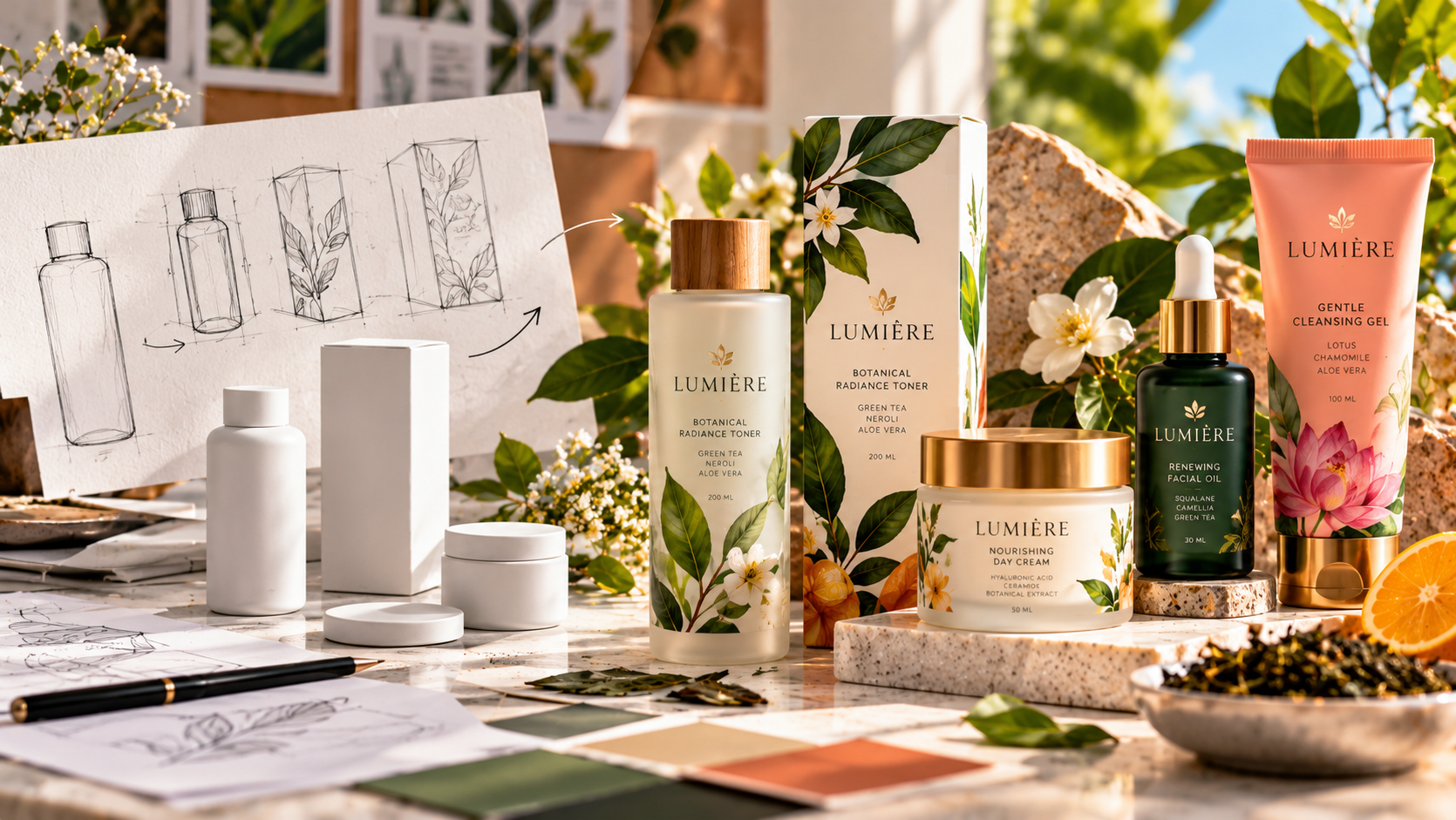
Packaging design is the process of developing the physical structure, visual presentation and information system used to contain, protect, communicate and present a product.
It encompasses several interconnected disciplines.
Structural design considers the packaging’s form, dimensions, construction, durability and practical functionality.
Graphic design establishes the visual language through elements such as logos, typography, colours, imagery and layout.
Brand communication determines how the packaging expresses the product’s positioning, personality and intended value.
Information design organises product details, usage instructions and other information customers need.
Material selection considers production requirements, product protection, usability, environmental implications and cost.
Effective packaging design brings these considerations together.
A visually appealing package may fail if it is difficult to open, unsuitable for transporting the product or unable to communicate essential information.
Likewise, a technically functional package may offer limited brand recognition if its design is indistinguishable from competing products.
Good packaging design combines functional suitability with clear communication and a recognisable brand identity.
2. Why Packaging Matters Before Customers Experience the Product
Unlike many services, physical products can be evaluated visually before customers experience their actual performance.
Packaging often provides the first opportunity to communicate what the product represents.
A customer may encounter the packaging on a supermarket shelf, in an online product listing, through a social media post or during the unboxing experience.
Each environment influences how the product is presented.
For unfamiliar brands, packaging can help customers answer several immediate questions.
What is this product?
What does it do?
Who is it intended for?
How is it different from the alternatives?
What level of quality or experience should I expect?
Customers may not consciously evaluate every element of packaging design, but the overall presentation can influence the way they interpret the product.
Packaging Creates Expectations
Consider two hypothetical coffee brands.
One uses bright colours, expressive typography and accessible product messaging.
The other uses a restrained visual identity, carefully considered materials and detailed information about sourcing and flavour characteristics.
Both may offer excellent coffee.
Yet their packaging communicates different personalities and expectations.
The first might emphasise everyday enjoyment and accessibility.
The second might emphasise craftsmanship and a more considered product experience.
Neither approach is inherently superior.
Its effectiveness depends on whether the packaging accurately represents the intended positioning and appeals to the relevant audience.
This is why packaging should begin with an understanding of the product and the business behind it.
3. Packaging Design and Product Branding: What’s the Difference?
Packaging design and product branding are closely related but serve different purposes.
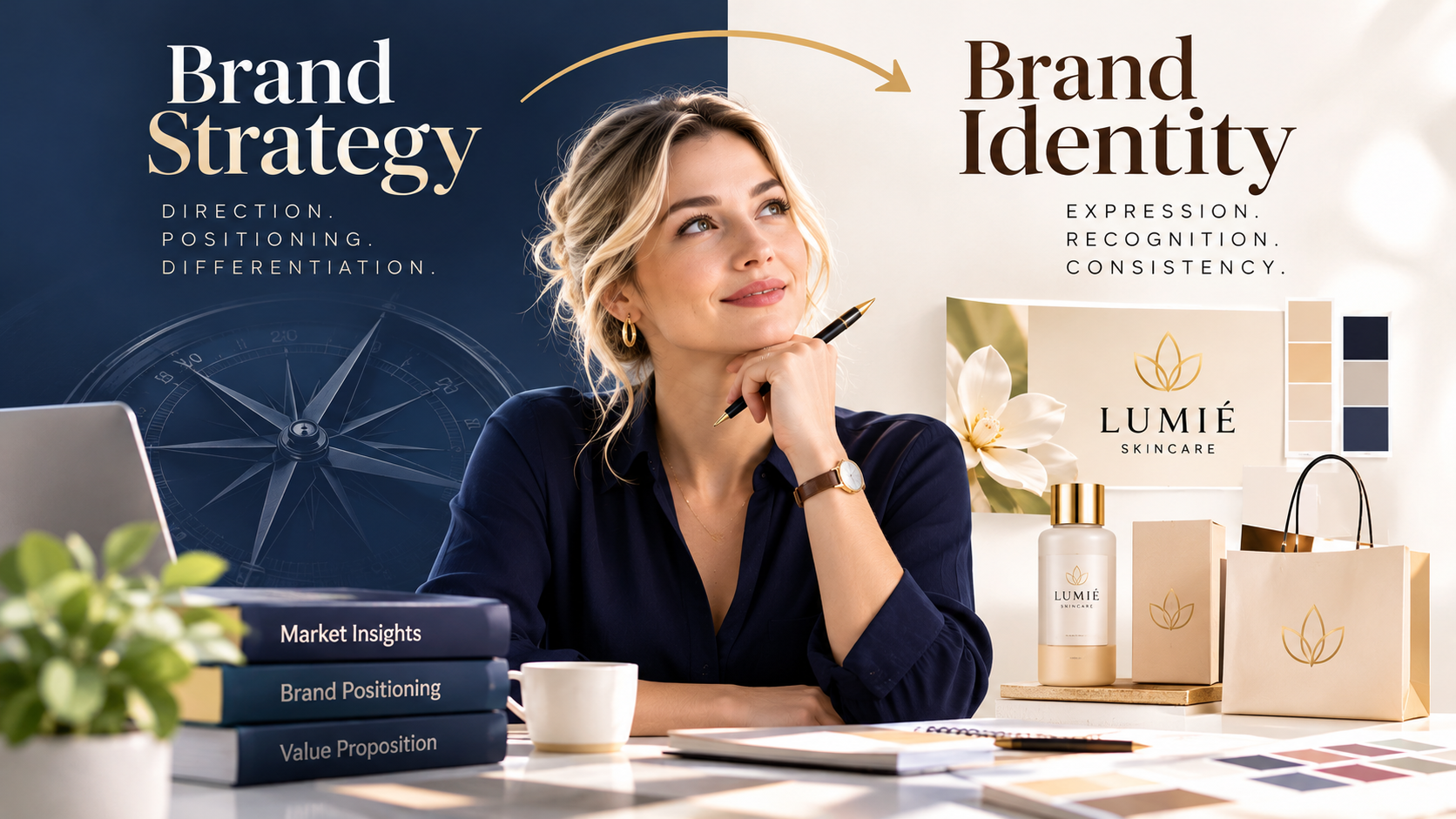
Product branding defines how a product is positioned, identified and understood relative to other offerings.
Packaging design translates that identity into a physical and visual experience suited to the product.
The distinction is important because packaging can be visually attractive without communicating a meaningful brand position.
A new skincare product, for example, may use elegant typography and contemporary colours.
However, those elements should reinforce something relevant about the product, such as its intended audience, formulation philosophy, usage experience or market positioning.
Design decisions become more coherent when informed by the brand’s strategic foundations.
Packaging Design vs Product Branding
| Dimension | Product Branding | Packaging Design |
|---|---|---|
| Primary purpose | Establish the product’s identity and position | Express and deliver that identity through packaging |
| Starting point | Audience, offering and value proposition | Product requirements and brand direction |
| Core questions | Why should customers consider this product? | How should the product be presented and experienced? |
| Typical outputs | Positioning, identity, messaging and brand principles | Structural concepts, artwork, materials and production specifications |
| Business contribution | Creates a coherent product identity | Supports recognition, communication and product experience |
The strongest outcomes emerge when these disciplines are developed together.
Packaging then becomes an expression of the product’s identity rather than an unrelated decorative exercise.
For entrepreneurs developing their first product, our guide on how to build a brand for a new business explains the strategic foundations that should guide identity development.
Before publishing, confirm that Article 04 is live at the linked URL.
4. Five Elements of Effective Packaging Design
Packaging decisions vary considerably between industries and product categories.
Nevertheless, five dimensions provide a useful basis for evaluating whether packaging is appropriate for the intended market.
1. Recognition
Can customers identify the product and associate it with its brand?
A coherent visual identity helps establish recognition across different packaging formats and product variations.
Elements such as typography, colours, symbols and graphic language should work together consistently.
Recognition does not require every product package to look identical.
It requires a recognisable relationship between the different expressions of the brand.
2. Communication
Does the packaging explain the product clearly?
Customers should be able to identify what the product is, understand its relevant characteristics and access important information.
Information hierarchy is therefore a central part of packaging design.
The product name, primary benefit, essential details and supporting information should be organised according to their importance.
3. Differentiation
Can customers distinguish the product from credible alternatives?
Distinctiveness may emerge through graphic design, structural form, colour, materials or a particular approach to presentation.
However, difference should be purposeful.
Unusual packaging is not necessarily effective if it confuses customers or compromises usability.
4. Functionality
Does the packaging protect the product and support its intended use?
Packaging must respond to practical requirements such as storage, handling, transportation, opening, dispensing and product protection.
These considerations are particularly important for food, cosmetics, healthcare products and other categories where product integrity matters.
5. Experience
What is it like for the customer to interact with the packaging?
The experience extends beyond the moment of purchase.
Opening, handling, storing, reusing and disposing of packaging all contribute to the interaction.
A thoughtful packaging experience should be appropriate to the product and the expectations of its intended audience.
Recognition, communication, differentiation, functionality and experience form the foundation of effective packaging design.
These dimensions will also form the basis of our evaluation framework later in this article.
5. How Packaging Helps Products Stand Out in Crowded Markets
Many product categories contain numerous brands competing for attention.
In these environments, businesses face a practical challenge.
Their products must be recognisable and understandable among competing alternatives.
Packaging can contribute to this objective by making the brand easier to identify and helping communicate its distinctive qualities.
However, standing out does not necessarily require louder colours, unusual shapes or more elaborate graphics.
Sometimes the most effective distinction is restraint.
A product surrounded by visually complex packaging may stand out through simplicity and clarity.
Another may benefit from expressive typography, a distinctive structural form or an unconventional material treatment.
The appropriate direction depends on the category and the brand.
Distinctiveness Is Not the Same as Difference
Packaging should be distinctive enough to support recognition while remaining understandable within the product category.
A customer purchasing a nutritional supplement, for example, needs to recognise the nature of the product and understand relevant information.
A highly experimental design that obscures these details may create attention without supporting informed evaluation.
This illustrates the relationship between branding and commercial communication.
Good packaging should be distinctive without making the product difficult to understand.
Our earlier perspective on branding for competitive advantage explores why meaningful differentiation and brand recognition should work together.
6. The Role of Colour, Typography and Materials
Packaging is often one of the most concentrated expressions of a brand’s visual identity.
A relatively small physical surface must communicate multiple elements simultaneously.
Design decisions therefore deserve careful consideration.
Colour
Colour contributes to recognition and helps establish the visual character of the product.
However, colour associations are not universal.
Their interpretation can vary according to cultural context, product category and customer expectations.
The appropriate palette should therefore be informed by the brand’s positioning and practical requirements.
Typography
Typography influences how clearly information is communicated.
It can also contribute significantly to the character of a product.
A contemporary lifestyle product may use a different typographic approach from a technical healthcare product.
However, visual character should never compromise legibility.
Text must remain readable at the sizes used on the packaging.
Materials and Finishes
Paper, board, glass, metal, plastic and other materials create different tactile and practical experiences.
Surface finishes, printing techniques and structural details can also influence the way a product is perceived.
Material selection should balance intended brand expression with protection, manufacturing feasibility, cost and environmental implications.
Premium packaging does not necessarily require excessive material use or elaborate finishing.
Often, quality emerges from carefully considered proportions, restrained design and appropriate construction.
7. Packaging Design for New Product Launches
For entrepreneurs, packaging can be one of the most complex elements of bringing a physical product to market.
The creative process must accommodate practical decisions about manufacturing, product protection, information requirements and costs.
A new business may initially focus on developing an attractive identity.
However, packaging needs to be designed for its actual production and distribution environment.
Questions to Answer Before Developing Packaging
What are the product’s dimensions and physical characteristics?
How will the product be stored and transported?
Where will customers encounter it?
What information must appear on the packaging?
Which materials are appropriate?
What are the production quantities and cost constraints?
Will the design need to accommodate multiple product variations?
These decisions influence the packaging’s feasibility and should be considered before final artwork is completed.
Start With the Product Requirements
For example, a company developing a premium tea range may require packaging that protects the product from environmental exposure while presenting different flavours coherently.
The visual system must accommodate multiple products without losing the brand’s recognisable identity.
A skincare business may need packaging formats that support different product sizes, ingredients and dispensing requirements.
A technology hardware company may prioritise product protection, clear identification and a considered unboxing experience.
In each case, the packaging must respond to the needs of the product.
Packaging design should be shaped by the business, the product and the customer—not simply by the visual preferences of the founder.
8. Sustainable Packaging Requires More Than a Green Appearance
Environmental considerations have become increasingly relevant to packaging decisions.
Businesses may explore ways to reduce material use, improve recyclability, increase recycled content or introduce reusable packaging formats.
However, sustainable packaging should not be understood simply as packaging that looks environmentally friendly.
Natural colours, botanical imagery and paper-like textures do not establish that a package has a lower environmental impact.
The relevant questions concern material choices, production processes, transportation, product protection, use and end-of-life management.
Sustainability and Practical Performance
A package made from less material is not necessarily the best option if it fails to protect the product adequately.
Similarly, a theoretically recyclable material may provide limited benefit where suitable collection or recycling systems are unavailable.
Businesses should evaluate environmental decisions alongside functional and commercial requirements.
This is particularly relevant for organisations operating in Singapore.
The National Environment Agency’s Mandatory Packaging Reporting scheme requires qualifying producers of packaged products and retailers to report packaging data and submit plans to reduce, reuse or recycle packaging.
The scheme generally applies to businesses meeting specified conditions, including annual turnover exceeding S$10 million. Requirements should be checked against the current regulations and the organisation’s circumstances.
Read the National Environment Agency’s guidance on Mandatory Packaging Reporting.
Singapore has also introduced a technical reference for sustainable packaging that considers the packaging life cycle, including design and end-of-life management. National Environment Agency
For businesses, the principle is clear.
Sustainable packaging begins with informed design decisions, not environmental imagery.
Claims about sustainability should be specific, supportable and relevant to the actual package.
9. When Should a Business Consider Packaging Redesign?
Packaging can become less effective as a business evolves.
A product may enter new markets, reach different customers or expand into additional categories.
Its existing packaging may no longer reflect its positioning.
In other circumstances, the visual design remains appropriate, but the packaging’s functionality, information hierarchy or production efficiency needs improvement.
These situations require different responses.
Common Reasons for Packaging Redesign
Brand repositioning
The product’s intended market position has changed, and its packaging no longer communicates the desired identity.
Product portfolio expansion
The business has introduced additional products and needs a more coherent packaging system.
Changing customer expectations
Existing packaging may no longer meet customer needs for usability, convenience or information.
Production considerations
The business may need to improve material efficiency, simplify manufacturing or adjust packaging structures.
Regulatory requirements
Changes in applicable information or labelling requirements may necessitate packaging updates.
Visual inconsistency
Packaging has developed across multiple products without a coherent brand identity.
Not all these situations require a complete redesign.
Sometimes a focused update to typography, information hierarchy or structural details may be sufficient.
The appropriate approach begins with understanding the business problem.
10. The Byràv Packaging Evaluation Framework
Before commissioning new packaging, businesses can benefit from evaluating their existing designs through a consistent set of questions.
We recommend examining five dimensions:
Recognition → Communication → Differentiation → Functionality → Experience
This framework is intended as a practical decision-making tool rather than a scientifically validated measurement system.
The Five-Dimension Packaging Assessment
| Dimension | Key Question | Potential Improvement |
|---|---|---|
| Recognition | Can customers identify the brand and product? | Strengthen identity consistency |
| Communication | Is essential information clear and accessible? | Improve information hierarchy |
| Differentiation | Does the packaging establish a meaningful distinction? | Review visual positioning |
| Functionality | Does the packaging protect and support the product? | Refine materials or structure |
| Experience | Is the packaging convenient and appropriate to use? | Improve handling and interaction |
How to Use the Framework
Begin by reviewing the packaging in its intended environment.
A supermarket product should be assessed alongside competing products.
An e-commerce product should be evaluated through its online presentation, delivery and unboxing experience.
A professional or industrial product may require greater attention to identification, handling and technical information.
For each dimension, consider whether the current packaging performs its intended function.
Identify the areas where customer understanding, recognition or usability could be improved.
Where possible, test the packaging with people who resemble the intended customer audience.
The objective is not to produce an arbitrary overall score.
It is to identify the most relevant design priorities.
A Question for Business Leaders
If customers encountered your product without prior knowledge of your company, would its packaging communicate what the product is, why it matters and what distinguishes it from the alternatives?
If the answer is uncertain, the issue may extend beyond visual design.
It may indicate a need to revisit product positioning, brand identity or packaging strategy.
For organisations considering a new product identity or packaging redesign, a discussion with Byràv Designs can help clarify the creative and practical requirements.
11. What Should You Look for in a Packaging Design Partner?
Selecting a packaging design partner should involve more than evaluating attractive portfolio images.
The appropriate partner should demonstrate an understanding of the relationship between branding, customer experience and practical production requirements.
Before beginning an engagement, consider several questions.
Does the team seek to understand the product and its intended audience?
Can it explain how the proposed design supports the brand’s positioning?
Does the scope include structural considerations where required?
Are the proposed materials and finishes appropriate for production?
How will the design accommodate different products or packaging sizes?
What artwork, specifications and production-ready deliverables will be provided?
How will prototypes, revisions and supplier coordination be handled?
The answers can help businesses understand what is included in a proposal and where additional expertise may be necessary.
A sophisticated visual concept is valuable, but the final packaging must also be appropriate for its intended use.
12. Frequently Asked Questions
What is packaging design?
Packaging design is the process of developing a product’s physical structure, visual presentation and information system. It combines product protection, branding, communication, materials and usability to create packaging suited to the product and its intended customers.
Why is packaging design important for branding?
Packaging is a physical expression of a brand. It can help customers recognise a product, understand its positioning and experience the brand through its design, materials, structure and functionality.
How does packaging influence buying decisions?
Packaging can influence how customers identify, interpret and evaluate a product before purchase. Clear information, recognisable branding, appropriate design and functional considerations may contribute to customer perceptions, although purchasing decisions also depend on price, product quality and other factors.
What is the difference between packaging design and product branding?
Product branding establishes a product’s positioning, identity and intended customer perception. Packaging design translates that identity into the physical and visual presentation of the product while addressing practical requirements.
What makes good packaging design?
Good packaging design combines recognition, clear communication, meaningful differentiation, appropriate functionality and a considered customer experience. It should also meet relevant production, safety and information requirements.
Does premium packaging need expensive materials?
Not necessarily. Premium packaging can be achieved through thoughtful typography, proportions, materials, construction and consistency. The appropriate investment depends on the product, customer expectations and production requirements.
When should a company redesign its packaging?
Packaging redesign may be appropriate when a business changes its positioning, expands its product range, enters new markets or identifies problems with usability, consistency or production. The scope of redesign should reflect the underlying challenge.
How can startups approach packaging design?
Startups should begin by clarifying their product positioning, customer audience and practical packaging requirements. They can then develop a coherent visual identity, evaluate suitable structures and materials, and test concepts before committing to production.
Conclusion: Packaging Is Where Brand Identity Becomes Tangible
A product’s packaging serves several purposes simultaneously.
It protects the product.
It communicates essential information.
It helps customers recognise the brand.
And it shapes the physical experience of discovering, purchasing and using the product.
Effective packaging design does not treat these responsibilities as separate concerns.
It brings them together through a coherent understanding of the product, the customer and the business behind it.
For entrepreneurs launching a new product, this means considering packaging as part of brand development from the beginning.
For established businesses, it means periodically examining whether packaging continues to communicate the product’s intended value and meet changing customer expectations.
The most compelling packaging is not necessarily the most elaborate.
It is the packaging that makes the product easier to recognise, understand and experience.
Because packaging does more than contain a product. It gives the brand a physical expression.
Bringing Product Brands to Life
At Byràv Designs, we believe thoughtful packaging begins with understanding the product and the business behind it.
Our approach connects strategic perspective with creative intelligence to develop distinctive product identities, packaging concepts and visual experiences.
Whether you’re preparing to launch a new product or reconsidering an established packaging identity, we welcome the opportunity to understand your ambitions.