


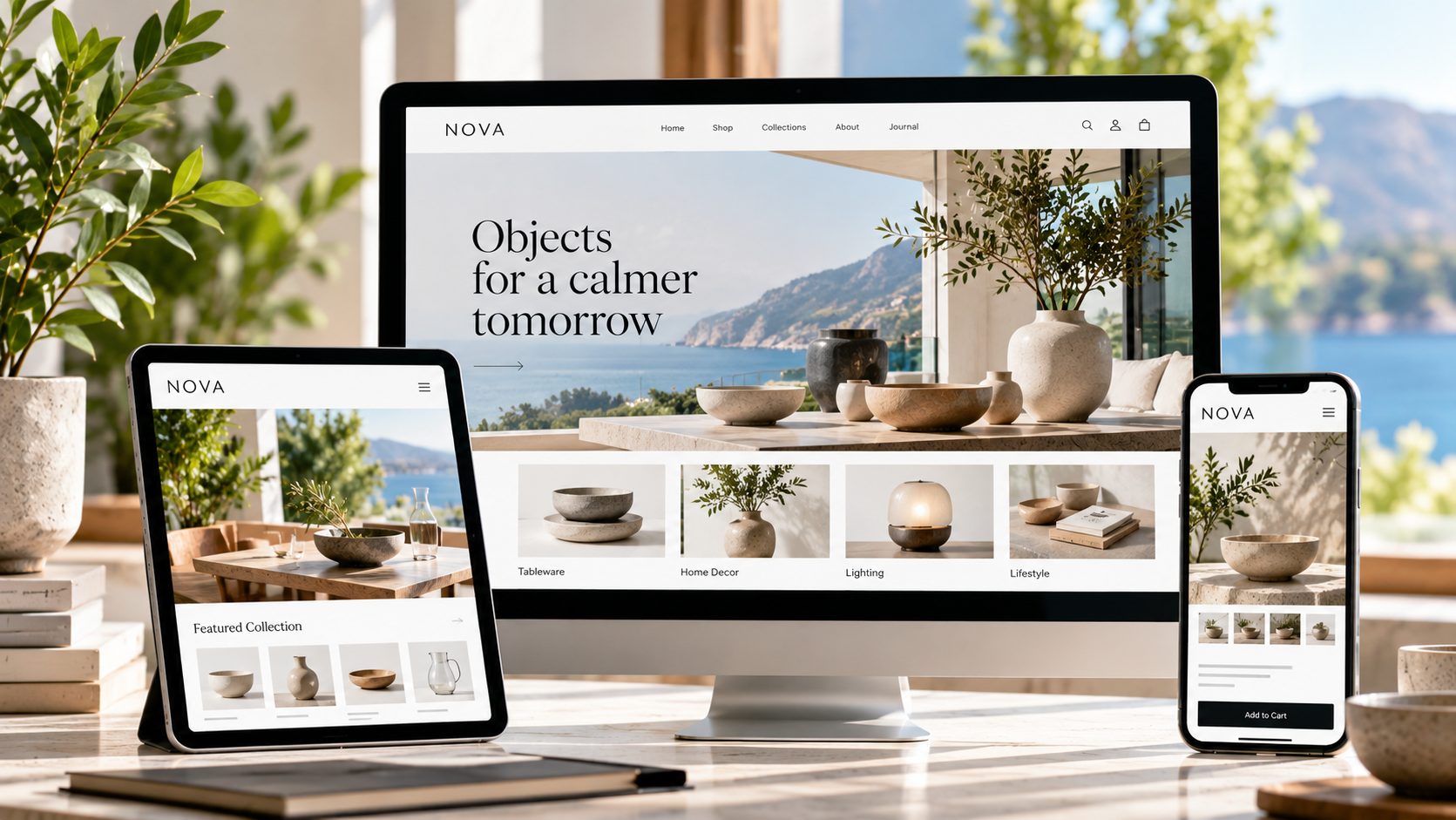
How thoughtful website design strengthens corporate identity, business credibility and the experience customers have with your brand.
A corporate website is often one of the first places a prospective customer encounters a business.
Before arranging a meeting, requesting a proposal or speaking with a representative, visitors may already have explored the organisation’s website.
They may have examined its services, reviewed its expertise, considered its experience and formed an initial impression of its credibility.
Yet many businesses still approach their websites primarily as digital brochures.
They present company information, list their capabilities, display selected projects and provide contact details.
These functions are important, but they represent only part of what an effective corporate website should accomplish.
Corporate website design should do more than present information. It should help customers understand the business, recognise its value and navigate towards a meaningful next step.
A website is an expression of the organisation’s identity, positioning and customer experience.
Its design influences how the business is perceived. Its content determines how effectively the organisation communicates. Its structure shapes how visitors discover relevant information.
For business leaders, the question is therefore not simply whether their organisation has a professional-looking website.
It is whether that website accurately reflects the business and supports the expectations of the people it is intended to serve.
1. What Is Corporate Website Design?
Corporate website design is the process of creating and maintaining a digital presence that communicates an organisation’s identity, capabilities, information and value to its intended audiences.
It involves more than visual styling.
Effective corporate website design brings together brand strategy, information architecture, content, user experience and technical functionality.
The objective is to create a coherent digital environment in which visitors can understand the organisation and accomplish relevant tasks.
These tasks may include evaluating services, reviewing expertise, exploring projects, understanding product capabilities or contacting the business.
A corporate website may also serve investors, prospective employees, business partners and other stakeholders.
Its design must therefore balance different information needs without compromising clarity.
Corporate Website vs Digital Brochure
A digital brochure primarily presents information.
A considered corporate website creates opportunities for exploration, interaction and decision-making.
| Dimension | Digital Brochure Approach | Strategic Corporate Website |
|---|---|---|
| Primary purpose | Present company information | Communicate value and support user needs |
| Content | Services and company descriptions | Audience-focused information and relevant evidence |
| Navigation | Organised around internal departments | Organised around visitor needs and tasks |
| Brand identity | Mainly visual presentation | Integrated visual, verbal and experiential identity |
| User experience | Reading and browsing | Understanding, evaluating and taking action |
| Measurement | General website visits | Relevant engagement and business outcomes |
| Development | Periodic content updates | Ongoing refinement based on changing needs |
A simple website is not necessarily inferior to a complex one.
The distinction lies in whether the experience is designed intentionally around the business and its audiences.
2. Your Website Is an Expression of Corporate Identity
A corporate brand is communicated through many interactions.
Its website is one of the most visible.
The organisation’s typography, colours, imagery, tone of voice and presentation of information all contribute to the experience.
But identity extends beyond visual consistency.
A company positioning itself around precision and technical expertise should communicate those qualities through the clarity of its explanations, the organisation of its content and the reliability of its website.
A consultancy emphasising strategic understanding should demonstrate that perspective through the questions it addresses and the insights it shares.
A premium product brand should deliver a digital experience consistent with the quality and character of its physical products.
In each case, the website should reinforce what the brand represents.
This is why website design should not be treated as a disconnected technology project.
The digital experience should express the same positioning, character and commitments that define the wider organisation.
A website can be visually sophisticated and still misrepresent a business if its messaging, structure or experience conflicts with the organisation’s actual capabilities.
Our perspective on why branding is a strategic business asset explores this relationship between identity, perception and business value.
3. Why Visual Sophistication Alone Is Not Enough
A beautiful website can create a positive first impression.
However, aesthetics cannot compensate indefinitely for unclear information, confusing navigation or a poor user experience.
Imagine arriving at the website of a professional services firm.
The page features sophisticated animations, attractive photography and elegant typography.
Yet after several minutes, you still cannot determine what the company specialises in or whether it serves organisations like yours.
The design may be memorable.
But it has not fulfilled one of the website’s most important responsibilities: helping you evaluate the business.
This distinction is supported by research into website credibility.
The Stanford Web Credibility Project identified several factors associated with credible websites, including appropriate professional design, clearly presented expertise, useful information, accurate content and accessible contact details.
Its research remains a useful historical foundation, although the studies predate many contemporary digital behaviours and should not be interpreted as current conversion benchmarks.
Explore Stanford’s guidelines for website credibility.
The practical lesson is that visual design and information quality should reinforce one another.
A website should look appropriate for the organisation it represents while making relevant information easy to understand.
4. Five Elements of an Effective Corporate Website
The requirements of a corporate website depend on the organisation and its audiences.
However, five dimensions provide a useful starting point for evaluating effectiveness.
1. Clear Positioning
Visitors should be able to understand what the organisation does, whom it serves and why its capabilities matter.
This does not require every detail to appear on the homepage.
It requires a clear introduction and a logical path towards more detailed information.
Generic statements about excellence or innovation may sound impressive without communicating a meaningful distinction.
Specific, relevant explanations are often more useful.
2. Credible Information
Customers need reasons to believe the organisation’s claims.
Credibility may be supported through accurate company information, relevant experience, authentic projects, clearly explained capabilities and verifiable professional credentials.
The appropriate evidence depends on the business.
A technology company may need to demonstrate technical understanding.
A professional services firm may need to explain its expertise and approach.
A design consultancy may benefit from showing representative work and the thinking behind it.
Claims should remain proportionate to what the organisation can substantiate.
3. Coherent Brand Identity
The website should express the organisation’s identity consistently.
Typography, imagery, colour, language and layout should work together to create a recognisable experience.
Consistency does not mean that every page must look identical.
It means that the design system remains coherent across different content types and functions.
4. Intuitive User Experience
Visitors should be able to locate relevant information without unnecessary effort.
Navigation should reflect how audiences understand the organisation’s offerings.
Important information should be accessible across desktop and mobile devices.
Forms, buttons and other interactions should behave predictably.
Accessibility also matters. Clear content structure, readable contrast, usable controls and appropriate alternative text help make the experience more inclusive.
5. Meaningful Next Steps
A corporate website should help visitors progress towards actions appropriate to their needs.
For some visitors, that may mean reviewing a service in greater detail.
Others may want to explore a relevant project, download information or initiate a conversation.
The aim is not to force every visitor towards an immediate enquiry.
It is to make the next relevant step clear and accessible.
These five dimensions—positioning, credibility, identity, experience and next steps—provide a foundation for evaluating corporate website effectiveness.
5. Website Design and Digital Brand Experience Are Not the Same Thing
Website design often describes the process of creating a website’s structure, interfaces and visual presentation.
Digital brand experience takes a broader perspective.
It considers how the organisation’s identity, content, interactions and functionality collectively shape the experience of the brand.
A website is one environment in which that experience takes place.
Consider an organisation that positions itself as an accessible, customer-focused technology partner.
A website filled with complex terminology, unclear navigation and difficult-to-use enquiry forms would conflict with that positioning.
Even if the visual design were attractive, the experience would communicate something different from the brand’s intended promise.
Conversely, a clear, intuitive website can help reinforce the qualities the organisation wants customers to associate with it.
The relationship can be expressed simply:
Brand strategy establishes what the organisation intends to communicate. Website design and digital experience determine how visitors encounter that intention online.
This is why an effective digital presence should connect creative design with business understanding.
6. How Website Design Influences Business Credibility
A website cannot create genuine expertise or replace organisational performance.
However, it can influence whether visitors recognise those qualities.
Business customers often face uncertainty when evaluating unfamiliar organisations.
They may not know the company personally.
They may be unfamiliar with its capabilities.
They may be comparing several providers before deciding whom to contact.
A clear, professional website can help reduce some of that uncertainty.
It does so by making information accessible, presenting the organisation consistently and allowing visitors to evaluate relevant evidence.
What Builds Credibility Online?
The following elements can contribute to a more credible digital presence:
Clear company information: Explain the organisation’s purpose, capabilities and relevant background.
Transparent communication: Make it straightforward to understand services, processes and contact options.
Authentic evidence: Present genuine projects, credentials or other relevant proof of capability.
Consistency: Ensure messages, imagery and visual identity reinforce one another.
Reliability: Maintain functioning pages, accurate information and usable interactions.
Credibility is not established by decorative elements alone.
It emerges from the relationship between what the website communicates and what the organisation can demonstrate.
For businesses considering changes to their corporate identity, this principle also applies to the wider brand.
Our guide on when a business outgrows its brand identity explores situations in which external presentation no longer reflects organisational capabilities.
7. When Does a Corporate Website Need Redesigning?
A website does not require redesign simply because its visual style has been in place for several years.
Some established websites remain effective long after their original launch.
Equally, a recently designed website may already be failing to meet business requirements.
The decision should therefore be based on relevance, usability and organisational needs rather than age alone.
Seven Signs a Website May Need Attention
1. The business has evolved.
The website no longer reflects the organisation’s current capabilities, audiences or market positioning.
2. Visitors struggle to understand the offering.
Services are described unclearly, important information is difficult to locate or the organisation’s differentiation is not communicated.
3. The design no longer reflects the brand.
The website’s visual presentation is inconsistent with other corporate communications or the organisation’s intended positioning.
4. Mobile usability is inadequate.
Important content is difficult to read or interactions are difficult to complete on smaller screens.
5. Technical performance interferes with the experience.
Slow loading, unstable layouts or unresponsive interactions create unnecessary friction.
6. The content structure has become fragmented.
Pages have accumulated without a coherent information architecture, making navigation increasingly difficult.
7. The website does not support relevant visitor actions.
Visitors cannot easily explore services, review evidence or make contact.
These symptoms may require different responses.
Not all justify a complete rebuild.
8. Website Refresh, Redesign or Redevelopment: Which Is Appropriate?
These terms are sometimes used interchangeably, but they can represent different levels of intervention.
A website refresh generally involves focused improvements to content, visual details or individual components without substantially changing the underlying structure.
A website redesign involves broader changes to layout, navigation, user experience, information architecture or visual presentation.
A website redevelopment may involve substantial technical changes, such as replacing the underlying content management system, rebuilding functionality or restructuring integrations.
The appropriate approach depends on the problem.
| Situation | Potential Approach |
|---|---|
| Visual details need refinement | Website refresh |
| Messaging is outdated | Content and positioning update |
| Navigation is confusing | UX and information architecture redesign |
| Corporate identity has changed | Website redesign aligned with the new brand |
| Existing technology cannot support requirements | Technical redevelopment |
| Mobile performance is poor | Targeted optimisation or redesign |
| Multiple issues affect the entire experience | Comprehensive website review |
A well-considered engagement should establish the nature of the challenge before recommending a particular solution.
Replacing the entire website may be unnecessary when focused improvements can address the underlying problem.
Equally, cosmetic changes may be insufficient when structural or technical limitations are substantial.
9. Technical Performance Is Part of the Brand Experience
Digital experience is shaped by more than appearance and content.
Technical performance contributes to how easily visitors can use a website.
Slow loading, unstable layouts and delayed responses can interfere with otherwise well-designed interactions.
Google’s Core Web Vitals provide three useful measures of real-world page experience.
Largest Contentful Paint (LCP) concerns loading performance.
Interaction to Next Paint (INP) measures responsiveness to user interactions.
Cumulative Layout Shift (CLS) measures unexpected visual movement.
Google recommends working towards an LCP of 2.5 seconds or less, INP of 200 milliseconds or less, and CLS of 0.1 or less at the 75th percentile of page visits.
These measurements help identify technical issues, but they should not be viewed as a complete assessment of website quality.
A technically fast website may still communicate poorly.
Likewise, an attractive website may frustrate visitors if its interactions are unreliable.
The objective is to bring design quality, usability and technical performance together.
Read Google’s guidance on Core Web Vitals.
10. The Byràv Corporate Website Assessment Framework
Before committing to a website redesign, business leaders can undertake a structured evaluation of their current digital presence.
We recommend examining five dimensions:
Clarity → Credibility → Identity → Experience → Conversion
Each addresses a different question about the website’s effectiveness.
Dimension 1: Clarity
Can visitors quickly understand what the organisation does, whom it serves and why its offering matters?
Review the homepage introduction, service descriptions and navigation.
Dimension 2: Credibility
Does the website provide relevant, accurate and verifiable reasons to trust the organisation?
Consider company information, expertise, authentic projects and communication quality.
Dimension 3: Identity
Does the website reflect the organisation’s intended positioning and visual character?
Examine typography, colours, imagery, messaging and consistency with other brand applications.
Dimension 4: Experience
Can visitors navigate and interact with the website comfortably across devices?
Review usability, accessibility, performance and content structure.
Dimension 5: Conversion
Does the website make appropriate next steps clear?
This may involve an enquiry, a consultation request, access to detailed information or another meaningful action.
Conversion should be defined according to the organisation’s objectives rather than treating every visitor as an immediate sales opportunity.
Corporate Website Self-Assessment
| Dimension | Assessment Question | Potential Improvement |
|---|---|---|
| Clarity | Can visitors understand our value proposition? | Refine positioning and messaging |
| Credibility | Do we demonstrate relevant expertise? | Improve evidence and company information |
| Identity | Does our website reflect our brand? | Strengthen the visual and verbal system |
| Experience | Is the website intuitive and accessible? | Improve navigation and usability |
| Conversion | Are meaningful next steps easy to find? | Refine user journeys and calls to action |
A practical way to use the framework is to rate each dimension from 1 to 5.
A score of 1 indicates a significant concern.
A score of 5 indicates that the website meets the organisation’s current requirements effectively.
The scores are not a scientifically validated website performance index. They are a structured discussion tool designed to help leadership teams identify priorities.
Importantly, a low score in one dimension does not automatically justify redesigning the entire website.
The purpose is to identify the specific issues preventing the digital experience from serving the business effectively.
A Question for Leadership
If a prospective customer knew nothing about your organisation and encountered your website today, would the experience communicate the quality, sophistication and relevance of the business behind it?
If the answer is uncertain, the challenge may deserve more attention than a cosmetic redesign.
For organisations reassessing their digital presence, a conversation with Byràv Designs can help establish whether the priority is brand clarity, website design or a broader digital experience.
11. What Should Businesses Look for in a Website Design Partner?
Choosing a website design partner should involve more than comparing visual portfolios.
The appropriate partner should understand the organisation’s objectives, audiences and technical requirements.
Some projects primarily require creative expertise.
Others involve complex content structures, systems integration, user research or significant technical redevelopment.
Before engaging a provider, consider several questions.
Does the team seek to understand the business before proposing a solution?
Can it explain how the design will communicate the organisation’s positioning?
Does its approach account for content, mobile usability and accessibility?
Can it distinguish between visual redesign and necessary technical changes?
How will the website be maintained and updated after launch?
What deliverables, responsibilities and assumptions are included in the proposal?
These questions can help businesses make more informed decisions.
A successful website engagement should produce an appropriate digital experience—not simply a collection of attractive page designs.
12. Frequently Asked Questions
What is corporate website design?
Corporate website design involves creating a digital presence that communicates an organisation’s identity, capabilities and value. It combines visual design, content, navigation, user experience and technical functionality to support the needs of customers and other stakeholders.
Why is a corporate website important for business?
A corporate website helps prospective customers discover, understand and evaluate an organisation. It provides information, demonstrates relevant expertise and creates opportunities for meaningful interaction. Its effectiveness depends on the clarity and quality of the experience it delivers.
What makes a good corporate website?
An effective corporate website communicates a clear value proposition, presents credible information, reflects the organisation’s brand identity, provides intuitive navigation and supports relevant visitor actions. Accessibility, mobile usability and technical performance also matter.
What is the difference between website design and digital brand experience?
Website design focuses on the creation of a website’s structure, appearance and functionality. Digital brand experience considers how identity, content and interactions collectively shape the way visitors understand and experience the organisation online.
How do I know whether my website needs redesigning?
Consider whether the website accurately reflects your current business, communicates your value clearly and allows visitors to navigate comfortably. Outdated messaging, confusing navigation, inconsistent branding or persistent usability problems may indicate the need for improvement.
Should a company redesign its website or build a new one?
The decision depends on the underlying problems. A redesign may be sufficient when the website’s technology remains suitable, while redevelopment may be necessary when structural or technical limitations prevent the site from meeting business requirements.
Does website design affect SEO?
Website design can influence SEO through content structure, navigation, mobile usability, accessibility and technical performance. However, visual appearance alone does not determine rankings. Useful content and the site’s broader search accessibility remain essential considerations.
Can a professional website improve business credibility?
A clear, appropriate and reliable website can support credibility by helping visitors understand the organisation and evaluate its expertise. Credibility also depends on authentic evidence, business performance and the consistency of the organisation’s wider interactions.
Conclusion: Your Website Should Reflect the Business Behind It
A corporate website should not exist merely because every business is expected to have one.
It should serve a meaningful purpose.
It should communicate what the organisation represents, help visitors understand its capabilities and provide an experience consistent with its positioning.
Design contributes to that experience.
So do content, usability, technical performance and the clarity of the organisation’s communication.
When these elements are considered together, a website becomes more than a digital collection of company information.
It becomes a coherent expression of the business and a useful environment for the audiences it serves.
For business leaders, the most valuable question is not whether their website looks contemporary.
It is whether the website helps people understand the organisation they are considering.
A well-designed website should not merely describe the business. It should make the business easier to understand, evaluate and engage with.
Digital Experiences That Reflect Your Ambition
At Byràv Designs, we believe a corporate website should be an extension of the organisation’s identity and ambitions.
Our approach combines strategic understanding, creative intelligence and considered digital design to create coherent brand experiences.
Whether you’re developing a new corporate website or reassessing an existing digital presence, we welcome the opportunity to understand your objectives.