

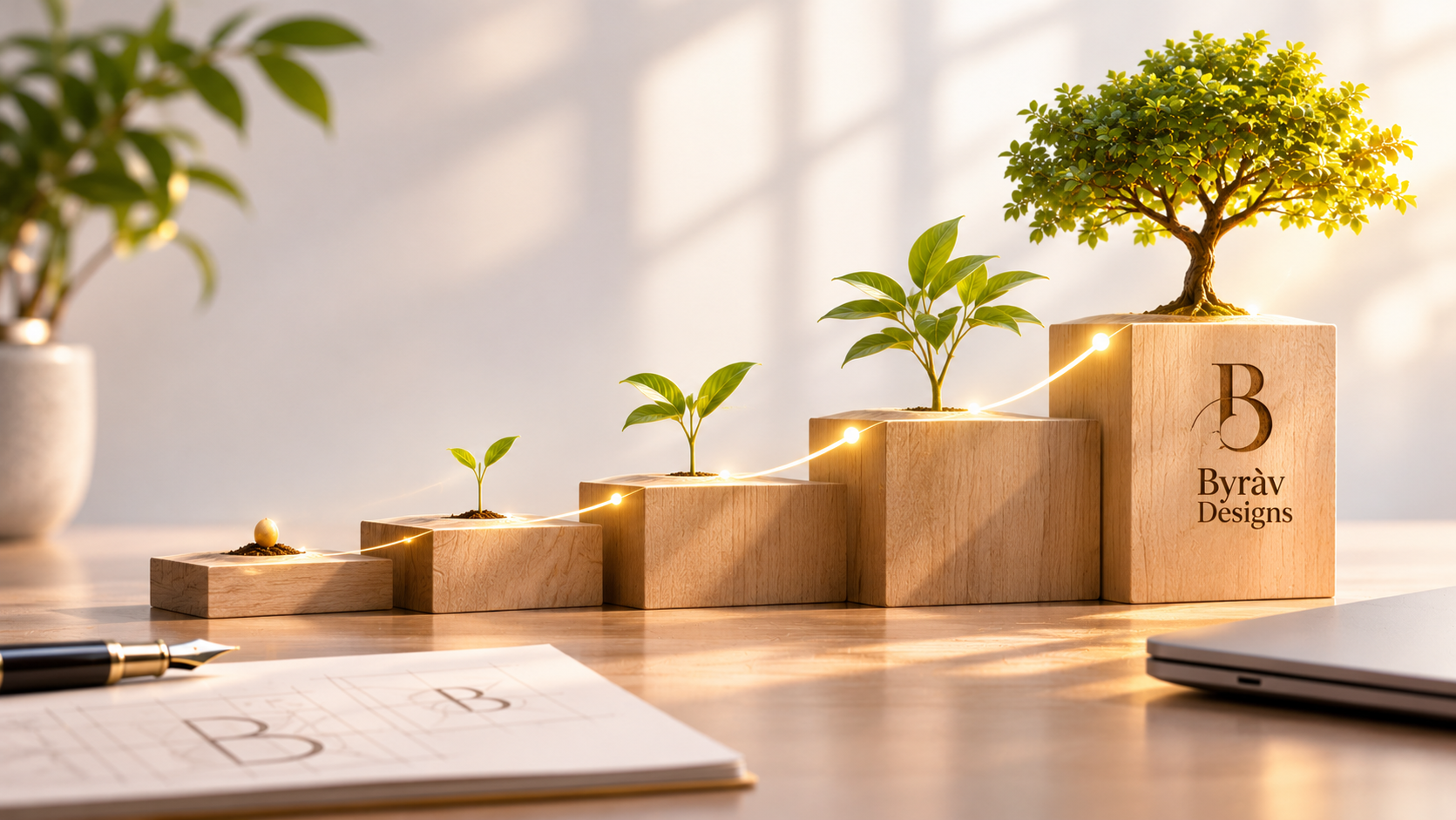
Why choosing the right design partner is not simply about finding an agency, but finding the right expertise to support your business through every stage of growth.
Branding agency vs creative agency vs web design agency—which is right for your business? A branding agency primarily helps define a brand’s positioning and identity. A creative agency develops design and communication solutions, while a web design agency focuses on digital experiences and website implementation.
However, these distinctions are not always clear-cut. Many agencies offer overlapping capabilities, and the right choice depends on your business’s stage of development, objectives and requirements.
For business owners, the question is therefore not necessarily which type of agency is better.
It is whether the selected partner can understand the business, translate its ambitions into a coherent identity and support its evolution over time.
A business may begin with an idea, launch its first product, establish its market presence and eventually expand across industries or geographical markets.
At each stage, its brand and communication requirements evolve.
Choosing the right design partner can help ensure that these developments contribute to a consistent business identity rather than creating disconnected design assets.
This guide examines the differences between branding agencies, creative agencies and web design companies, and explains when businesses may benefit from a more integrated strategic design partnership.
1. What Does a Branding Agency Do?
A branding agency helps organisations define and communicate who they are, what they represent and why they are relevant to their intended audiences.
Its work often begins before visual design.
Depending on the agency, services may include:
- Brand strategy and positioning
- Customer and competitive analysis
- Brand architecture
- Naming and messaging
- Corporate identity development
- Logo and visual identity systems
- Brand guidelines
- Brand refresh and rebranding
A branding agency may be particularly valuable when a business is entering a market, launching a new offering, repositioning itself or addressing inconsistencies in its existing identity.
For example, an established professional services company may have developed several business divisions over time.
Although each division operates successfully, customers may struggle to understand how the different services relate to the parent company.
In this situation, a branding engagement could help clarify the organisation’s positioning, brand architecture and overall communication system.
The objective is not necessarily to produce a new logo.
It is to create a more coherent understanding of the business.
For a deeper discussion, read our article on why branding is a strategic business asset.
2. What Does a Creative Agency Do?
A creative agency focuses on developing ideas, visual expressions and communication materials that help a business engage with its audiences.
Depending on the agency’s specialisation, this may include:
- Creative concept development
- Corporate communications
- Graphic design
- Campaign creative
- Marketing collateral
- Editorial and publication design
- Product and packaging design
- Visual storytelling
- Digital creative assets
Creative agencies often translate an established brand strategy into customer-facing materials.
For example, a consumer product company launching a new range may require packaging concepts, product imagery, promotional materials and retail communications.
A creative agency could help bring these elements together into a consistent visual presentation.
Some creative agencies also provide extensive strategic branding capabilities, while others focus primarily on implementation and production.
This is why businesses should evaluate the actual services offered rather than relying exclusively on the term creative agency.
3. What Does a Web Design Agency Do?
A web design agency specialises in creating and implementing websites and other digital experiences.
Its work may include:
- Website planning and information architecture
- User experience (UX) design
- User interface (UI) design
- Responsive website development
- Content management systems
- Ecommerce website implementation
- Technical integration
- Website testing and maintenance
A web design agency may be the appropriate choice when a business already has an established brand identity and needs a professionally implemented website.
However, a website is also one of the most visible representations of a company’s brand.
If the organisation’s positioning, messaging or identity is unclear, website development alone may not resolve those underlying issues.
This is particularly relevant for established businesses undertaking a redesign.
A visually improved website may still communicate an inconsistent brand if its underlying strategy remains undefined.
Our guide on how to choose the best website design company in Singapore explains how businesses can evaluate potential digital design partners.
4. Branding Agency vs Creative Agency vs Web Design Agency: Key Differences
The three categories can be compared according to their typical responsibilities.
| Dimension | Branding Agency | Creative Agency | Web Design Agency |
|---|---|---|---|
| Primary emphasis | Brand strategy and identity | Creative communication and design | Digital experiences and implementation |
| Business positioning | Often central | Varies by agency | Usually secondary |
| Logo and identity | Core capability | Often offered | May be offered |
| Corporate communications | Often included | Core capability for some agencies | Typically limited |
| Packaging design | May be offered | Common specialisation | Usually outside core scope |
| Website UX/UI | May be offered | Sometimes offered | Core capability |
| Website development | Varies | Varies | Core capability |
| Long-term brand consistency | Often a central concern | Depends on engagement | Depends on scope |
These are typical distinctions, not fixed industry definitions. The capabilities of individual firms may overlap significantly.
The practical question is whether the business needs one specialised deliverable or coordination across several related requirements.
5. Why the Right Agency Changes as a Business Grows
A startup and an established enterprise rarely face identical brand challenges.
Consider how the requirements of a business may evolve.
Stage 1: From Business Idea to Brand Identity
At the beginning, an entrepreneur may have a promising idea, technical expertise or an innovative product.
However, the business may not yet have a clear market position or recognisable identity.
The immediate need may involve:
- Defining the brand proposition
- Understanding the intended customers
- Establishing a name and identity
- Creating initial communication materials
- Developing a credible digital presence
At this stage, the focus is on translating an idea into a business that customers can understand and recognise.
Stage 2: From Launch to Market Presence
Once the business enters the market, its requirements expand.
It may need product packaging, a stronger website, corporate presentations, digital communication and customer-facing materials.
The challenge becomes maintaining consistency while engaging different audiences.
A business that works with multiple disconnected providers may encounter inconsistencies in messaging and visual identity unless there is strong coordination.
Stage 3: From Market Presence to Differentiation
As competitors enter the market, the business may need to communicate what makes its offering distinctive.
Brand positioning, customer experience and design consistency become increasingly important.
The organisation may need to refine its identity, improve its website or restructure how its products and services are presented.
This stage often requires both strategic and creative capabilities.
Stage 4: From Established Business to Expansion
A growing organisation may enter new markets, launch additional products or acquire other businesses.
Its brand system may need to accommodate multiple audiences, divisions and geographic regions.
The challenge is no longer simply producing communication materials.
It is maintaining a coherent identity while the organisation becomes more complex.
The role of design therefore evolves with the business—from establishing an identity to strengthening differentiation, credibility and long-term consistency.
This is why the continuity of a strategic design partnership can become valuable.
6. Why Businesses May Need an Integrated Design Partner
Traditional agency selection often begins with a particular deliverable.
A company needs a logo, so it approaches a branding agency.
It needs packaging, so it approaches a packaging design specialist.
It needs a website, so it approaches a web development company.
These decisions may be entirely appropriate when requirements are clear and independent.
However, business challenges are not always organised around agency categories.
A company undergoing rebranding may also need a new website.
A business launching a consumer product may require brand positioning, packaging, product communication and digital experiences.
An established enterprise expanding internationally may need to harmonise corporate identity and communications across multiple markets.
These activities are interconnected.
When they are developed independently without shared strategic direction, inconsistencies can emerge.
An integrated design partner can help coordinate the relationship between business positioning, brand identity, customer experience and the different materials used to communicate with the market.
The advantage is not simply having several services available under one roof. It is having a consistent strategic perspective connecting those services.
For businesses undergoing broader change, this can provide continuity while allowing the scope of design work to evolve.
7. The Brand Growth Partnership Framework: Five Capabilities to Evaluate
Businesses evaluating a long-term design partner can use a five-part framework.
This framework focuses on the capabilities needed to support a brand as the organisation develops.
1. Strategic Clarity
Can the partner understand the business model, market context, target customers and strategic objectives?
Design should begin with a clear understanding of the problem it is intended to address.
2. Brand Coherence
Can the partner establish or maintain a consistent brand identity across products, services and communication channels?
A coherent identity helps audiences recognise and understand the organisation.
3. Creative Expression
Can the partner translate the strategy into distinctive and appropriate visual communications?
This may include corporate identity, packaging, digital content, presentations and other brand materials.
4. Digital Experience
Can the partner create digital experiences that reflect the organisation’s identity and support its customer interactions?
The website should not be treated as separate from the broader brand.
5. Evolution and Continuity
Can the partner support changes in the organisation’s needs over time?
A business may require an initial identity, followed by a website, product launch materials, corporate communications or a broader brand refresh.
The ideal partnership should accommodate that evolution without losing strategic coherence.
This framework is informed by established design thinking principles, including the Design Council’s Double Diamond, which emphasises understanding and defining a problem before developing and delivering solutions.
For businesses evaluating creative partners, this is an important consideration: the quality of the final design depends partly on how well the underlying business challenge has been understood.
8. Byràv Designs: A Strategic Partner Through the Business Growth Journey
At Byràv Designs, we approach design through the relationship between business ambition, brand identity and customer experience.
We recognise that businesses do not remain at the same stage of development.
A company establishing its identity today may require a sophisticated digital presence tomorrow.
An established brand entering new markets may need to reconsider its communication system.
A business introducing new products may require packaging and visual experiences that remain consistent with its overall positioning.
These needs are connected by a common requirement: maintaining clarity as the business evolves.
Our approach brings together four complementary areas of expertise.
Brand Strategy & Identity
We help organisations establish and refine the way they are positioned, recognised and understood.
This encompasses the strategic and visual foundations of a coherent brand.
Digital Brand Experiences
We translate brand identity into considered digital experiences, connecting communication, design and the way customers interact with a business online.
Packaging & Product Branding
We develop brand expressions for products and packaging, supporting consistency between the product, its presentation and the organisation behind it.
Corporate Communications & Design
We help businesses communicate with clarity and consistency through corporate materials, presentations, publications and other professional touchpoints.
These capabilities can be commissioned individually or considered as part of a broader engagement.
What connects them is a consistent design philosophy: understanding the business first, then developing the appropriate expression of its identity.
We see our role not simply as delivering individual design outputs, but as helping organisations create and maintain coherence as they grow.
This does not mean every business requires all four service areas.
It means businesses should have access to the capabilities appropriate to their stage of development, supported by a shared understanding of their broader objectives.
9. What Should You Look for When Choosing a Long-Term Design Partner?
When comparing branding agencies, creative studios and website design companies, consider the following questions.
Does the agency understand our business beyond the immediate project?
A partner should be able to discuss your customers, market context and objectives—not merely the deliverables.
Can it demonstrate relevant creative and strategic capabilities?
Review completed work, methodologies and the reasoning behind design decisions.
Will it maintain consistency across our brand touchpoints?
Consider how identity, website design, packaging and communications will work together.
Can the engagement evolve as our requirements change?
Clarify whether the agency can support future projects without requiring an entirely new strategic starting point.
Is the scope of work transparent?
Understand which services are included, which require specialist support and how responsibilities are managed.
Can the agency explain the value of its recommendations?
Design decisions should relate to defined objectives rather than being justified purely by aesthetics.
Google’s guidance on helpful, reliable, people-first content also reinforces the importance of clear, substantive information and demonstrable expertise when businesses develop their digital presence.
The same principles of clarity, credibility and usefulness are valuable when evaluating the quality of an agency’s communication.
10. Should You Work With One Agency or Multiple Specialists?
There is no universally correct answer.
A single integrated partner can offer continuity, consistent communication and shared strategic direction.
Multiple specialists may be appropriate where a project requires highly specialised technical expertise or services beyond the scope of one agency.
For example, an organisation developing a complex software application may need specialist engineering capabilities alongside its branding and user experience work.
Similarly, businesses with established internal brand teams may prefer to commission specialist creative services for particular projects.
The key consideration is coordination.
Whether a business works with one partner or several, its brand strategy and communication principles should remain consistent.
For growing organisations, a strategic design partner can help maintain this consistency while collaborating with other specialists when necessary.
11. Frequently Asked Questions
What is the difference between a branding agency and a creative agency?
A branding agency typically focuses on brand strategy, positioning and identity development. A creative agency generally develops visual concepts and communication materials. Many agencies offer both services, so businesses should evaluate the actual scope and expertise of each provider.
Is a branding agency better than a web design agency?
Neither is inherently better. A branding agency may be more appropriate when the business needs positioning or identity development. A web design agency may be better suited to implementing an established digital brief. Businesses requiring both may benefit from an integrated strategic design partner.
Which agency should I hire when starting a new business?
A new business should first consider whether its positioning, intended audience and brand identity are clearly defined. If these foundations are missing, strategic branding may be a useful starting point before commissioning extensive website or marketing materials.
Can one agency handle branding, website design and packaging?
Some multidisciplinary consultancies can coordinate all three areas. Businesses should assess the agency’s actual capabilities, relevant portfolio and delivery approach rather than assuming that all services are included.
What is the best design agency for a growing business in Singapore?
The best partner depends on the company’s objectives and stage of growth. Businesses should prioritise relevant experience, strategic understanding, coherent design capabilities, transparent processes and the ability to support future requirements. There is no single agency that is best suited to every organisation.
Do I need to rebrand when my business grows?
Not necessarily. Growth does not automatically require rebranding. However, businesses may benefit from reviewing their brand if their existing identity no longer reflects their services, market position or intended audiences.
Read our perspective on when a business outgrows its brand identity.
Why is long-term brand consistency important?
Consistency helps customers encounter a coherent identity across different products, services and communication channels. It can support recognition, clarity and a more unified customer experience as the business expands.
Should I hire a strategic design consultancy instead of separate agencies?
A strategic design consultancy may be beneficial when a project involves interconnected branding, digital and communication requirements. Separate specialists may be suitable for well-defined or highly technical tasks. The decision should reflect the scope and complexity of the organisation’s needs.
Conclusion: Choose a Partner for Where Your Business Is Going
The decision between a branding agency, creative agency and web design agency should begin with the needs of the business.
A company establishing its market presence may need strategic identity development.
A growing consumer brand may need packaging and digital experiences.
An established enterprise may need to strengthen corporate communication and maintain consistency across several business divisions.
These requirements may appear different, but they are connected by the ongoing development of the brand.
A good design partner responds to today’s requirements. A strategic growth partner also understands how those requirements may evolve tomorrow.
At Byràv Designs, we believe design should support the business journey—not exist as a collection of disconnected projects.
Our approach connects brand strategy, identity, digital experiences, packaging and corporate communications through a consistent understanding of the organisation behind them.
From establishing an initial brand presence to strengthening an established corporate identity, we aim to help businesses translate ambition into clear, coherent and distinctive brand experiences.
Because the strongest brands are not built through a single design exercise. They develop through a continuing relationship between business strategy, creative thinking and execution.
Explore our approach: Byràv Designs
Discuss your brand’s next stage: Contact Byràv Designs