

From your first business idea to a distinctive identity—a practical guide to building a brand that can grow with your ambitions.
Learning how to build a brand is one of the most important steps when starting a new business.
An idea begins to take shape. A product or service is developed. A market opportunity becomes clearer, and what was once a possibility gradually becomes something tangible.
Yet among the many decisions involved in launching a business, branding is often approached too late—or misunderstood altogether.
For some entrepreneurs, building a brand begins with designing a logo. For others, it involves choosing a business name, selecting colours and creating a website.
These are important steps. But they are not where effective branding begins.
Building a brand starts with understanding what your business represents, who it serves and why customers should choose it.
A distinctive visual identity gives that understanding a recognisable expression. A thoughtful brand strategy provides the direction behind it.
Whether you are launching a technology venture, professional services firm, consumer product, restaurant or independent business, the principles remain remarkably similar.
The objective is not simply to look professional from the beginning.
It is to establish a clear identity that can support the business as it develops.
This guide explores the essential steps involved in branding a new business, the mistakes worth avoiding and how to distinguish what you need today from what can evolve later.
1. How to Build a Brand: Start With Your Business, Not Your Logo
One of the most common mistakes entrepreneurs make is beginning the branding process with visual design.
They explore logos, colour combinations and typography before establishing what their business needs to communicate.
This can produce an attractive identity without a clear strategic foundation.
Before considering how your brand should look, begin with several fundamental questions.
What problem does your business solve?
Who is it intended to serve?
What makes your offering relevant?
Why should a customer choose you rather than an established alternative?
What do you want your business to become?
These questions help establish the relationship between your business model and its brand.
Consider two entrepreneurs launching skincare businesses.
The first intends to offer affordable everyday products to a broad consumer market.
The second is developing a premium range centred on carefully selected ingredients, scientific credibility and considered product experiences.
Both businesses operate in the same category, but their positioning, customer expectations and brand expression may differ considerably.
Their visual identities should reflect those differences.
A strong brand does not begin by asking what looks attractive. It begins by understanding what needs to be communicated.
For founders, this early clarity can prevent expensive revisions as the business develops.
2. Understand the Customers You Want to Attract
A new business cannot be relevant to everyone.
Successful branding requires understanding which audiences matter most and what those audiences value.
For a professional services firm, customers may prioritise expertise, reliability and confidence.
For a consumer product, considerations might include convenience, quality, lifestyle alignment or the experience of using the product.
For a technology venture, customers may need to understand an unfamiliar solution before they can appreciate its value.
Different audiences require different approaches to communication.
Begin by developing a practical understanding of your intended customers.
Consider their needs, preferences, expectations and the alternatives available to them.
Identify the problems they are trying to solve and the factors that might influence their decisions.
A useful exercise is to complete this statement:
Our business helps [specific audience] achieve [desired outcome] through [distinctive offering or capability].
For example:
We help independent hospitality businesses create distinctive packaging that reflects their brand and improves the customer experience.
This statement is not a finished brand positioning strategy.
But it forces clarity about whom the business serves and the value it intends to provide.
For new entrepreneurs, that clarity is far more valuable than selecting visual elements without understanding the audience.
3. Define What Makes Your Business Different
Entering an established market means customers already have alternatives.
Your business must therefore communicate a reason to be considered.
This does not necessarily require a revolutionary product or an entirely new business model.
Differentiation can emerge from expertise, customer experience, product quality, convenience, specialisation, design or a distinctive approach to an existing problem.
The important question is whether the difference is meaningful to your intended customers.
Consider a new management consultancy.
Describing the business as professional, innovative and customer-focused offers little differentiation because many competitors use similar language.
A more specific positioning might emphasise expertise in a particular industry, a distinctive delivery approach or a clearly defined business challenge.
Likewise, a new food brand may differentiate itself through its ingredients, packaging experience, product format or the audience it serves.
The purpose of brand positioning is to identify these distinctions and communicate them coherently.
A Simple Brand Positioning Exercise
Before developing your visual identity, document four elements:
Your audience: Who should recognise and value your business?
Your offering: What do you provide?
Your distinction: What makes your approach relevant or different?
Your promise: What should customers consistently expect?
These four elements establish a starting point for building a meaningful brand.
They can be refined as the business learns more about its customers and market.
4. Choose a Business Name That Can Grow With You
A business name is often one of the earliest expressions of brand identity.
It influences recognition, communication and how customers remember the organisation.
A good name should be appropriate for the brand’s positioning, reasonably easy for its intended audience to recognise and capable of supporting future development.
However, founders should avoid assuming that the most descriptive name is necessarily the strongest.
A name that describes a narrow service may become restrictive if the business expands.
Equally, a highly abstract name may require more effort to establish meaning.
There is no universal formula.
The appropriate choice depends on the business, audience and intended positioning.
Before committing to a name, consider its pronunciation, interpretation, relevance and suitability across the markets you intend to serve.
Check Availability Before Investing in Design
For entrepreneurs launching in Singapore, it is sensible to check the availability of the intended business name through the Accounting and Corporate Regulatory Authority (ACRA).
You should also consider domain availability and potential trademark conflicts.
The Intellectual Property Office of Singapore (IPOS) provides information and search resources relating to trademarks.
Business name approval, domain registration and trademark protection are separate considerations. Availability in one system does not necessarily establish rights in another.
Where legal protection is important, seek appropriate professional advice before making substantial investments in the identity.
5. Develop a Distinctive Visual Identity
Once the business positioning is sufficiently clear, visual identity development can begin.
This is where the organisation’s character is translated into a recognisable design language.
A visual identity extends beyond the logo.
It encompasses the colours, typography, imagery, layouts and design principles that shape how the business appears across different environments.
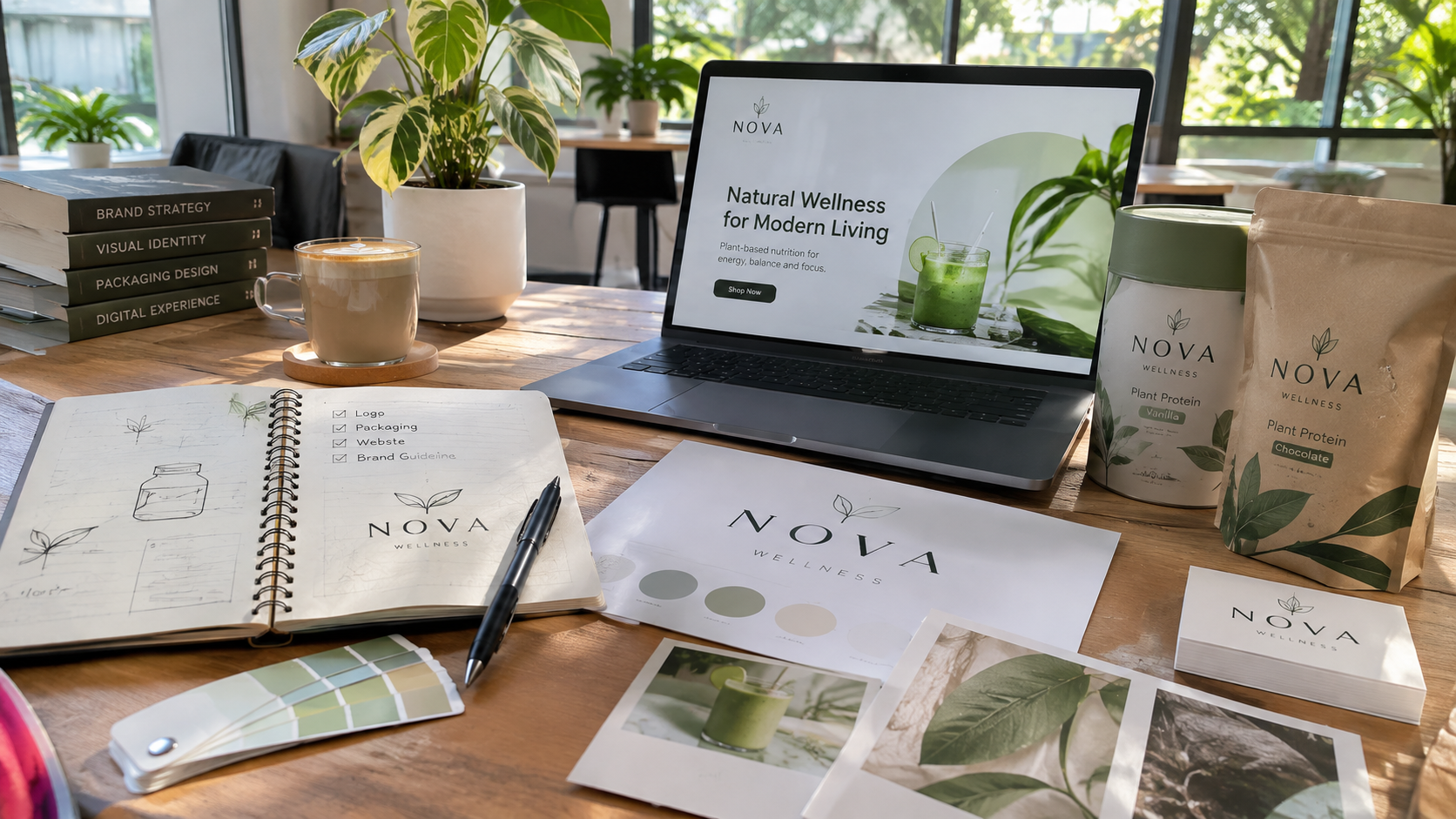
For a new business, the essential elements generally include a logo system, a considered colour palette, typography and basic guidelines governing their use.
These elements should be developed as a coherent system rather than independent design choices.
The Role of a Logo
A logo provides a recognisable symbol or expression of the business.
It may be typographic, symbolic or a combination of both.
Its effectiveness depends less on decorative complexity than on relevance, distinctiveness and appropriate application.
A logo should function across the contexts in which the business will operate.
This might include a website, social media profile, corporate presentation, product packaging or physical signage.
Colours and Typography
Colour and typography contribute to the character of a brand.
Their selection should consider audience expectations, legibility, accessibility and the positioning the business intends to establish.
A professional services firm may require a different visual language from a contemporary lifestyle product.
However, founders should be cautious about relying too heavily on simplistic assumptions about colour psychology.
Colour associations vary across cultures, categories and contexts.
The more useful question is whether the visual system works coherently for the business and its intended audience.
The objective is not to follow whatever design style is fashionable. It is to establish an identity that remains relevant beyond the immediate launch.
For founders exploring professional visual identity development, Byràv Designs’ corporate identity services provide a starting point for understanding how a consistent brand expression can be developed.
6. What Branding Assets Does a New Business Actually Need?
New entrepreneurs frequently face competing priorities and limited resources.
It can be difficult to determine which branding elements are essential before launch and which can be developed as the business grows.
The answer depends on the type of business.
A professional consultancy may prioritise its corporate identity, website and presentation materials.
A consumer product business may need packaging design before it can enter the market.
A restaurant may require menus, signage and packaging alongside its visual identity.
The following framework can help founders prioritise.
Essential Branding Assets vs. Future Investments
| Before Launch | Develop as the Business Grows |
|---|---|
| Clear business positioning | Extensive brand architecture |
| Business name and identity | More advanced brand applications |
| Primary logo and variations | Expanded identity systems |
| Core colours and typography | Comprehensive brand guidelines |
| Essential website or landing page | Larger digital platforms |
| Basic business communications | Extensive corporate publications |
| Product packaging, where necessary | Expanded packaging portfolios |
| Consistent brand messaging | Large-scale campaigns |
This is a practical guide rather than a universal checklist.
Some businesses may need more comprehensive branding before launch because of their customers, regulatory environment or route to market.
Others may begin with a focused identity and develop additional applications gradually.
The important principle is to establish a coherent foundation rather than purchasing every possible branding deliverable at the outset.
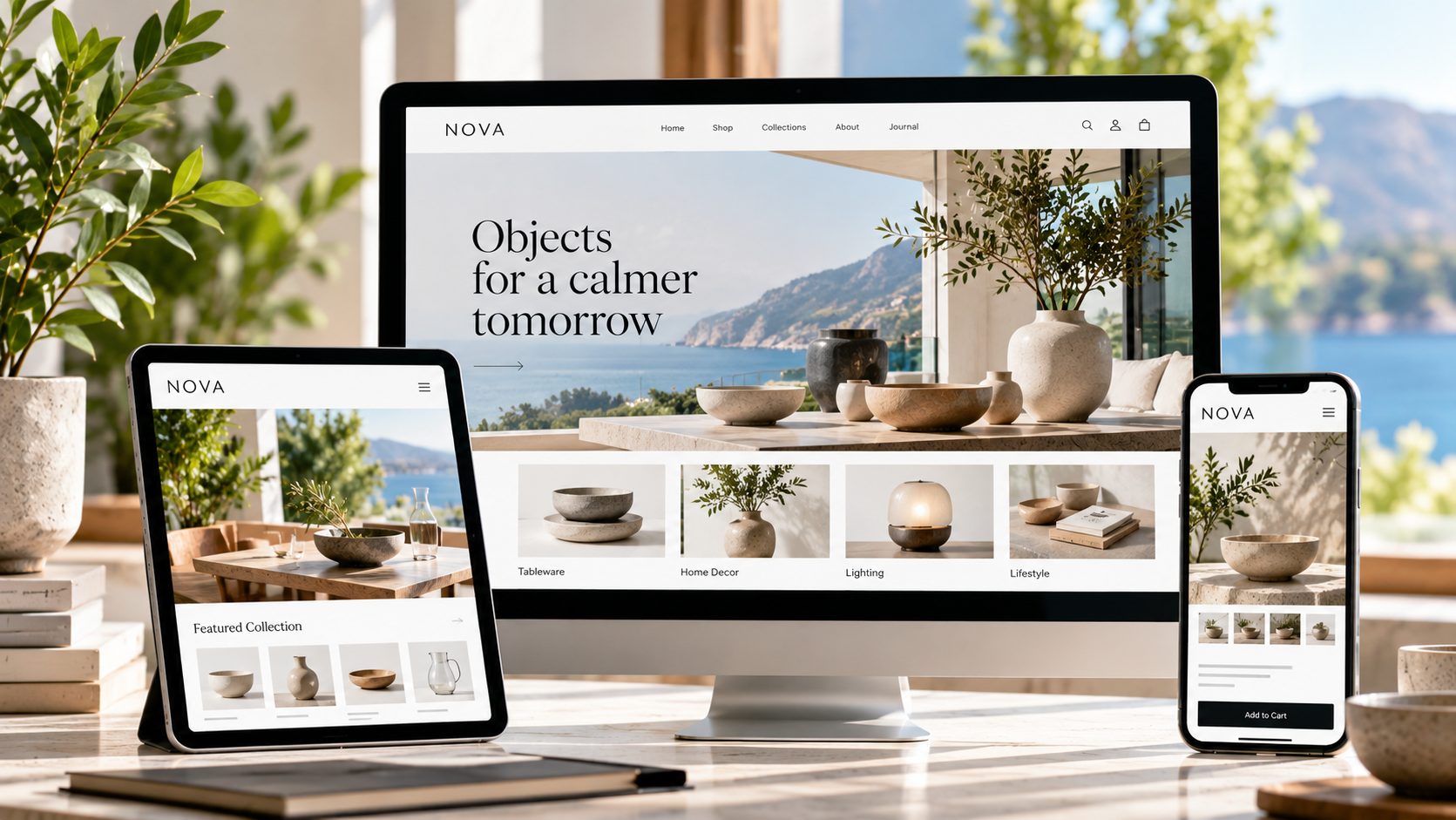
7. Build a Digital Presence That Reflects Your Business
For many new businesses, a website is the first substantial interaction customers have with the brand.
It is therefore more than a place to display contact details.
A considered website helps visitors understand what the business offers, whom it serves and why its capabilities matter.
For a new venture, this does not necessarily require an elaborate digital platform.
A focused, well-structured website can often serve the initial business requirements effectively.
The essential considerations include clear messaging, intuitive navigation, consistent visual identity, mobile usability and accessible contact information.
Visitors should be able to understand the nature of the business without having to interpret vague creative language or search extensively for basic information.
Design for the Customer, Not Just the Founder
Entrepreneurs naturally have strong personal connections to the businesses they create.
This can sometimes make website decisions overly subjective.
A design may appeal to the founder but fail to communicate effectively with prospective customers.
The more useful test is whether the website helps its intended audience understand the offering and take an appropriate next step.
A professional services website, for example, should communicate expertise and credibility.
A product business may need to emphasise product information, imagery and the purchasing experience.
A technology venture may need to explain the problem it addresses before describing its capabilities.
In every case, the digital experience should be an extension of the brand strategy—not a disconnected design exercise.
8. Consider Packaging as Part of the Brand Experience
For entrepreneurs launching physical products, packaging deserves particular attention.
Packaging is not simply a container.
It is a physical interaction between the customer and the brand.
Its materials, structure, typography, information hierarchy and visual expression all influence how the product is presented and experienced.
Consider two products with comparable functional characteristics.
One may communicate convenience and everyday accessibility.
The other may express craftsmanship, quality and a more considered experience.
Their packaging should help customers understand those propositions.
Effective packaging design brings together commercial, creative and practical requirements.
These may include protection, usability, production feasibility, information requirements and visual distinction.
The precise priorities depend on the product category.
For example, food, cosmetics and healthcare products may be subject to specific labelling requirements that must be considered alongside design.
Packaging Should Reinforce the Brand
A product’s packaging should not appear to belong to an entirely different organisation from its website or marketing materials.
It should express the same underlying identity while responding to the practical requirements of the product.
For founders, considering packaging early can help avoid inconsistencies between product development and brand presentation.
9. Five Branding Mistakes Entrepreneurs Should Avoid
Building a brand involves decisions that can have lasting implications.
Several common mistakes are worth recognising early.
Mistake 1: Designing Before Defining
Beginning with a logo before clarifying the business position can lead to an identity that looks attractive but communicates little.
Establish the strategic foundations first.
Mistake 2: Following Design Trends Too Closely
A fashionable visual style may offer immediate appeal but become less relevant as trends change.
Aim for a distinctive identity suited to the business rather than imitating the most visible competitors.
Mistake 3: Trying to Appeal to Everyone
An excessively broad brand position can make it difficult for customers to understand why the business is relevant to them.
Begin with a clear understanding of the audiences that matter most.
Mistake 4: Treating Every Branding Element Separately
A logo, website, product package and corporate presentation should not be developed as unrelated creative exercises.
A coherent brand foundation helps connect these applications.
Mistake 5: Building Only for the Immediate Launch
A business may begin with one product or service but develop broader ambitions.
An identity that is unnecessarily restrictive can create difficulties as the organisation expands.
Consider the business you are launching today while allowing reasonable flexibility for tomorrow.
10. Should You Create Your Own Branding or Engage a Professional?
Many entrepreneurs begin by developing their own branding.
For a business testing an early concept, this can be a reasonable way to establish a basic identity without committing substantial resources.
However, as the business becomes more established, the limitations of fragmented or improvised branding may become apparent.
Professional support becomes particularly relevant when the organisation needs clear market positioning, a distinctive identity, multiple design applications or a consistent brand system.
It may also be valuable when a founder lacks the expertise or capacity to coordinate these elements effectively.
The decision should be based on the complexity and objectives of the business, not simply on whether professional design appears more attractive.
When Professional Support May Be Valuable
Consider engaging a branding consultancy when your business:
- Is preparing for a commercial launch and needs a coherent identity.
- Operates in a competitive category where differentiation matters.
- Requires branding across websites, packaging and corporate communications.
- Needs to establish credibility with corporate customers or business partners.
- Is expanding beyond its original offering or entering new markets.
A professional engagement should begin with understanding the business rather than immediately recommending a predetermined set of design deliverables.
For guidance on evaluating external creative partners, explore our article on how to choose a corporate branding agency in Singapore.
11. A Practical Brand Launch Checklist for Entrepreneurs
Before launching your new business, consider whether you can confidently answer the following questions.
| Area | Question |
|---|---|
| Business purpose | Can we clearly explain what our business does? |
| Target audience | Do we understand whom we want to serve? |
| Brand positioning | Can we explain why customers should consider us? |
| Business name | Have we checked relevant name and domain availability? |
| Visual identity | Do we have a coherent logo, typography and colour system? |
| Brand messaging | Are we communicating our value consistently? |
| Website | Can visitors understand our offering and contact us easily? |
| Packaging | Does our product presentation reflect the brand, where applicable? |
| Brand consistency | Do our key customer-facing materials belong to the same identity? |
| Future growth | Can our identity accommodate reasonable business expansion? |
You do not need an elaborate brand programme to answer these questions.
But the more clearly you understand them, the easier it becomes to make purposeful design decisions.
12. Frequently Asked Questions
How do I start branding a new business?
Begin by defining your business purpose, target audience, value proposition and competitive positioning. Once these foundations are clear, develop a business name, visual identity, key messages and the essential digital or physical brand applications needed for launch.
Do I need a logo before starting a business?
A logo is not the first strategic requirement, but a recognisable visual identity is often useful before public launch. Start by establishing what the business represents and how it should be positioned, then develop a logo that expresses those foundations.
What is the difference between branding and marketing?
Branding establishes how a business is positioned, expressed and perceived. Marketing involves the activities used to communicate offerings, reach audiences and encourage engagement or demand. Effective marketing benefits from a clear and consistent brand foundation.
How much branding does a startup need?
The appropriate scope depends on the business model, audience and launch requirements. Most new businesses benefit from clear positioning, a coherent visual identity and consistent customer-facing materials. Product businesses may also require packaging, while service businesses often prioritise websites and corporate communications.
Can a small business build a strong brand?
Yes. Brand strength is not determined solely by company size or design expenditure. A small business can establish a distinctive identity by understanding its customers, communicating a clear value proposition and consistently delivering on its promises.
When should a startup hire a branding agency?
A startup may benefit from professional branding support when it needs strategic positioning, distinctive identity development or coordinated branding across multiple applications. The decision should reflect the venture’s commercial priorities, complexity and available resources.
Conclusion: Build the Brand With the Business in Mind
Launching a business requires balancing immediate practical needs with longer-term ambitions.
Branding should contribute to that balance.
A distinctive identity can help a new organisation communicate its purpose, establish recognition and present itself consistently.
But its value begins before the logo is designed or the website is launched.
It begins with understanding the business, the audience it serves and the distinction it intends to establish.
For entrepreneurs, the most important investment is not necessarily the most elaborate visual identity.
It is the clarity that allows every subsequent brand decision to serve a meaningful purpose.
Build the foundation thoughtfully. Give the identity room to evolve. And allow the brand to grow with the business behind it.
Building a Business Worth Recognising
At Byràv Designs, we bring strategic perspective and creative intelligence together to develop distinctive identities, digital experiences, packaging and corporate communications.
Whether you’re preparing to launch a new venture or establishing a more coherent identity for an emerging business, we welcome the opportunity to understand your ambitions.