

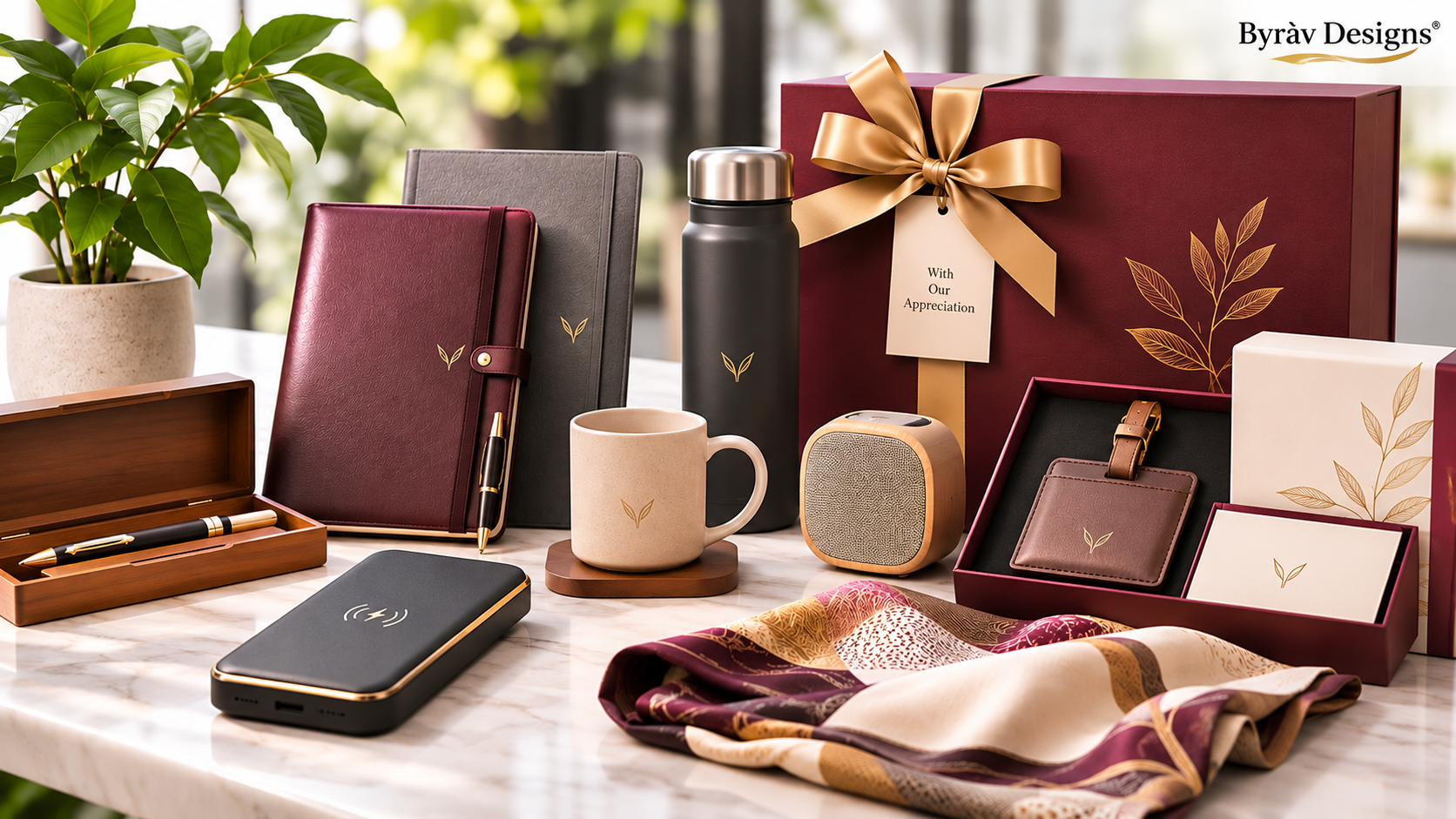
Corporate gifts Singapore businesses invest in can strengthen brand recognition, reinforce client relationships and create memorable experiences through thoughtful design and packaging.
For businesses investing in corporate gifts in Singapore, the real challenge is not finding something to give away.
It is selecting and designing something that recipients will appreciate, use and associate positively with the organisation.
Consider two companies attending the same industry conference.
The first distributes hundreds of inexpensive promotional items carrying an oversized corporate logo.
The second offers a smaller number of carefully selected gifts, designed around its brand identity and presented with attention to detail.
Both companies may achieve initial visibility.
But the impressions they create can be very different.
A recipient may discard an unwanted promotional item almost immediately. A useful, well-designed gift, however, may become part of their everyday environment.
Each subsequent encounter can serve as a reminder of the organisation that provided it.
The value of a corporate gift lies not simply in being received, but in being appreciated, remembered and associated with the right brand experience.
For business owners, this raises an important question: how should corporate gifts be approached as part of a wider branding strategy?
Why Are Corporate Gifts Important for Business Branding?
Corporate gifting creates an opportunity for businesses to establish or reinforce relationships through a tangible experience.
Unlike a digital advertisement or a corporate presentation, a physical gift can remain with the recipient beyond the initial interaction.
It may be used in an office, carried during travel, displayed in a workspace or incorporated into daily routines.
When the product is genuinely useful, each encounter can reinforce familiarity with the organisation.
Research published by the Promotional Products Association International (PPAI) identifies brand image, recognition and customer relationships among the reasons organisations invest in promotional products.
However, a gift does not automatically create goodwill simply because it carries a logo.
Its relevance, usability, presentation and appropriateness matter.
A well-considered gift may communicate that an organisation values quality and understands its audience.
An unsuitable gift may communicate very little—or create an impression of waste and poor judgement.
Corporate gifting should therefore be treated as a brand experience, not merely a procurement exercise.
What Is the Difference Between a Corporate Gift and a Promotional Giveaway?
Although the terms are sometimes used interchangeably, they often serve different business purposes.
A promotional giveaway is typically distributed to a relatively broad audience to support awareness, event participation or a campaign.
A corporate gift is often more selective, intended to recognise a relationship, express appreciation or mark an important occasion.
| Consideration | Promotional giveaway | Corporate gift |
|---|---|---|
| Primary purpose | Awareness and visibility | Relationship and appreciation |
| Typical audience | Event attendees or prospects | Clients, partners or employees |
| Distribution | Often relatively high volume | Often more selective |
| Personalisation | Usually limited | May be tailored to recipients |
| Presentation | Practical and efficient | More considered and distinctive |
| Brand expression | Visible brand identification | Often subtle and integrated |
Neither approach is inherently better.
A business participating in a large trade exhibition may reasonably prioritise practical, scalable giveaways.
A professional services company recognising a long-standing client relationship may require something more considered.
The important distinction is the intended outcome.
Before selecting a product, business owners should ask:
Are we trying to increase awareness, express appreciation, strengthen an existing relationship or create a memorable brand experience?
The answer should influence the gift’s design, value, presentation and distribution.
How Do Corporate Gifts Improve Brand Recognition?
Corporate gifts can reinforce recognition through repeated exposure to consistent brand elements.
These may include the company name, logo, colours, typography, packaging and other distinctive visual characteristics.
Consider a thoughtfully designed notebook used regularly in a client’s office.
The recipient encounters the gift repeatedly.
If its design is coherent with the organisation’s wider identity, those encounters can reinforce familiarity with the brand.
The same principle can apply to reusable drinkware, travel accessories, desk objects or other practical products.
However, repeated exposure is only valuable when the experience is positive.
An uncomfortable, inconvenient or poorly manufactured item may be abandoned regardless of how prominently the logo is displayed.
The design should therefore achieve two objectives:
Make the product desirable enough to use, and make its association with the brand recognisable enough to remember.
This creates an important balance between product usefulness and brand expression.
Why Do Some Corporate Gifts Feel Premium While Others Feel Cheap?
Perceived quality is influenced by several interconnected elements.
The product itself matters, but so do its proportions, materials, finish, packaging and overall presentation.
A relatively simple item can feel considered when its design is cohesive.
Conversely, an expensive product may feel ordinary when it is presented through inconsistent branding or poorly executed packaging.
Product Selection
A premium corporate gift should be appropriate for the recipient.
The objective is not necessarily to select the most expensive item.
It is to choose something that reflects the relationship and has a reasonable likelihood of being appreciated.
Materials and Finish
Material selection influences the visual and tactile experience.
A thoughtfully manufactured notebook, for example, may communicate greater care than a more elaborate item with poor finishing.
Durability is also important.
A gift that deteriorates quickly may create an impression inconsistent with the quality the organisation intends to communicate.
Visual Identity
Typography, colour, graphic composition and logo placement should be consistent with the brand’s identity.
A company positioned as understated and premium may weaken that impression through oversized promotional graphics.
Packaging and Presentation
The experience begins before the recipient uses the product.
The outer packaging, opening experience, arrangement and accompanying communication can influence how the gift is perceived.
For businesses considering the wider role of packaging, our article How Packaging Design Influences Consumer Buying Decisions explores related principles of product presentation and brand perception.
Premium gifting is not defined by price alone. It is defined by the consistency between the product, its presentation and the organisation’s intended brand character.
Should a Corporate Gift Display a Large Company Logo?
Not necessarily.
One of the most common mistakes in corporate gifting is assuming that a larger logo creates greater brand value.
A prominent logo may be appropriate for event merchandise or certain promotional campaigns.
However, excessive branding can make an otherwise attractive product feel like advertising material.
Research published by PPAI in 2025 found that 44% of surveyed consumers preferred subtle branding on promotional products.
This finding supports a useful design consideration: recipients may value an item more when the branding is integrated rather than overpowering.
A premium notebook might use a restrained embossed logo.
A travel accessory could incorporate the organisation’s colours or a distinctive graphic detail.
A gift box might feature the corporate identity more prominently, while the product inside carries subtler branding.
There is no universal rule.
The correct approach depends on the gift, its intended audience and the organisation’s positioning.
The goal should be brand recognition without compromising the desirability of the gift itself.
How Should Businesses Choose Corporate Gifts for Different Audiences?
A successful gifting strategy begins with understanding the recipient.
Different audiences have different expectations and relationships with the organisation.
Client Appreciation Gifts
A client appreciation gift should communicate thoughtfulness and respect for the relationship.
It need not be elaborate.
A carefully selected, practical item with refined presentation may be more appropriate than an expensive but impersonal product.
For long-standing clients, personalisation may add meaning when handled appropriately.
Employee Recognition Gifts
Employee gifts serve a different purpose.
They may celebrate achievements, recognise service milestones or support a sense of belonging.
The design should reflect the organisation’s internal culture and identity without becoming overly promotional.
A gift intended to recognise an individual should feel like appreciation rather than an advertising exercise.
Business Partner Gifts
Gifts for business partners should be professional, culturally appropriate and consistent with the nature of the relationship.
For organisations operating internationally, cultural considerations and recipient policies may influence what is suitable.
Particular care is needed when gifts could create conflicts of interest or appear intended to influence commercial decisions.
Conference and Exhibition Gifts
At conferences, practicality and portability often matter.
Attendees may receive numerous items throughout the event.
A useful, well-designed product can be more memorable than a novelty item that is quickly discarded.
The aim is to select something relevant to the audience and appropriate to the event.
Premium Executive Gifts
Executive gifts may warrant greater attention to materials, craftsmanship, personalisation and presentation.
However, discretion remains important.
Excessively lavish gifts may be inappropriate, particularly in regulated sectors or relationships involving procurement decisions.
The best gift is not always the most expensive.
It is the one that communicates appropriate recognition without creating discomfort or obligation.
How Does Packaging Make Corporate Gifts More Memorable?
Gift packaging is often the first part of the experience the recipient encounters.
It establishes expectations before the product is revealed.
A coordinated gift box may combine thoughtful material selection, a refined identity system and a clear presentation structure.
The packaging may also include a short message explaining the occasion or purpose of the gift.
For example, a corporate anniversary gift could use an identity developed specifically for the milestone while remaining consistent with the wider corporate brand.
A welcome gift for a new employee might express the organisation’s character through practical items, typography and a carefully designed message.
The packaging should not become unnecessarily complicated.
Excessive layers and decorative materials can increase costs and waste without improving the experience.
A thoughtful design balances presentation with practicality.
The most memorable gifting experiences are often those where the recipient feels that every detail has been considered.
What Are the Biggest Mistakes Businesses Make With Corporate Gifts?
Several recurring mistakes can weaken the value of an otherwise well-intentioned gifting programme.
Choosing Items Based Entirely on Unit Price
A low unit cost may appear commercially attractive.
However, if the gift is unused or discarded, its practical value may be limited.
Business owners should consider the relationship between cost, quality, relevance and expected use.
Printing the Logo Without Considering the Product
Branding should complement the object’s design.
Applying a large corporate logo without considering proportion, placement, material or finish can reduce the perceived quality of the gift.
Giving the Same Gift to Every Audience
A product suitable for a conference attendee may not be appropriate for an important business partner.
Audience relevance should guide gift selection.
Ignoring the Presentation
A carefully selected product presented carelessly may lose much of its intended impact.
Packaging and communication contribute to the overall experience.
Prioritising Novelty Over Usefulness
Unusual gifts can attract attention, but novelty alone does not make an item memorable for the right reasons.
A practical product that recipients genuinely appreciate may provide more meaningful ongoing exposure.
Disconnecting the Gift From the Brand
An attractive item with no meaningful relationship to the organisation’s identity can become a generic object.
The design should establish a coherent connection between the gift and the brand.
How Can Corporate Gifting Support Business Relationships Without Becoming Excessive?
Corporate gifts should express appreciation, not create an expectation of favourable treatment.
This distinction is particularly important in Singapore.
The Corrupt Practices Investigation Bureau (CPIB) explains that gifts and entertainment may arise in legitimate business relationships, but lavish, frequent or improperly motivated gifts can create corruption concerns.
Businesses should therefore consider their internal gifting policies, the recipient organisation’s rules and the circumstances in which a gift is offered.
A modest and appropriately timed gift may be suitable in one context but inappropriate in another.
Special care is warranted when recipients are involved in procurement, contract awards or other decisions that could create a conflict of interest.
For business owners, this reinforces a wider principle.
A corporate gift should strengthen an authentic relationship, not attempt to purchase one.
Are Sustainable Corporate Gifts Better for Brand Reputation?
Sustainability is increasingly relevant to how organisations evaluate physical products and packaging.
However, a gift should not be described as sustainable solely because it is made from a material that appears natural or carries an environmental label.
A more responsible approach considers whether the gift is genuinely useful, durable and appropriate for the recipient.
Unnecessary packaging should also be avoided.
Singapore’s National Environment Agency recommends choosing longer-lasting and useful corporate gifts as part of workplace waste-minimisation practices.
This creates an important connection between brand strategy and responsible design.
A business that presents itself as environmentally conscious should ensure that its gifting decisions are consistent with that positioning.
For example, distributing large volumes of disposable novelty items may communicate a different message from the one expressed in the company’s corporate communications.
Sustainable gifting should be evaluated through practical decisions rather than promotional claims.
How Should a Business Owner Budget for Corporate Gifts?
Corporate gifting budgets should begin with the intended business purpose, not simply an amount per item.
A practical budget should consider:
| Consideration | Business question |
|---|---|
| Audience | Who will receive the gifts? |
| Objective | What relationship or occasion are we recognising? |
| Quantity | How many recipients are involved? |
| Product quality | What level of quality is appropriate? |
| Brand design | Is customised artwork or identity development needed? |
| Packaging | How important is the presentation experience? |
| Logistics | What are the delivery and distribution requirements? |
| Compliance | Are recipient policies and approvals relevant? |
For a large exhibition, cost per unit and ease of distribution may be important.
For a limited client appreciation programme, personalisation and presentation may carry greater weight.
There is no universal ideal budget.
Businesses should select an approach appropriate to their circumstances and avoid assuming that greater spending automatically produces a better outcome.
The objective should be a coherent gifting experience within a responsible commercial framework.
Can Corporate Gifts Generate a Measurable Return on Investment?
Corporate gifting can support brand recognition and relationship-building, but directly attributing revenue to individual gifts is difficult.
A business may provide a gift to an existing client and subsequently receive additional work.
That does not prove that the gift caused the commercial outcome.
Relationships are shaped by service quality, trust, previous experience, pricing, business needs and many other factors.
A more realistic assessment considers whether the gifting programme achieved its intended objectives.
For example:
- Were gifts delivered appropriately and appreciated?
- Did recipients provide positive feedback?
- Was the product useful and relevant?
- Did the programme reflect the organisation’s intended identity?
- Were budgets and distribution managed responsibly?
- Did the programme support an existing relationship or meaningful business occasion?
These measures may provide useful evidence of programme quality without making unsupported revenue claims.
Corporate gifting should be treated as one element of a wider relationship and branding strategy—not as a guaranteed sales conversion mechanism.
What Makes a Corporate Gift Distinctively Branded?
An effective branded gift should be recognisable as part of the organisation without relying exclusively on a prominent logo.
This can be achieved through a combination of design elements.
The organisation’s colour palette may inform the packaging.
Typography can reinforce its visual character.
Materials and finishes can express its positioning.
A distinctive graphic motif may provide recognition across different items.
The accompanying message can reflect the company’s communication style.
Together, these elements create a more coherent experience.
A useful question for business owners is:
If the logo were made smaller, would the gift still feel like it came from our organisation?
If the answer is no, the design may not be making sufficient use of the wider brand identity.
This illustrates the difference between simply printing a company name on a product and translating a brand into a physical experience.
Byràv Designs: Corporate Gifting as an Extension of Brand Identity
At Byràv Designs, we view corporate gifting through the relationship between brand identity, product design, packaging and corporate communication.
A gift should not feel disconnected from the organisation presenting it.
Its selection, visual identity, packaging and accompanying message should communicate a consistent brand character.
This is where strategic branding and design become relevant.
Brand Strategy & Identity establishes how the organisation should be recognised.
Packaging & Product Branding translates that identity into physical objects and their presentation.
Corporate Communications & Design supports consistent messaging across relationships and occasions.
Digital Brand Experiences reinforce the same identity across the organisation’s online presence.
These disciplines work together to build a coherent impression.
For a business owner, the objective should not be to turn every corporate gift into an advertisement.
It should be to create a thoughtful, appropriate and recognisable expression of the organisation.
Sometimes, that expression is bold and distinctive.
Sometimes, it is understated.
The appropriate design depends on the brand, recipient and relationship.
A meaningful corporate gift should remind the recipient of the organisation through the quality of the experience—not merely the prominence of its logo.
Frequently Asked Questions About Corporate Gifts and Branding
Do corporate gifts really improve brand recognition?
Corporate gifts can reinforce brand recognition when recipients use or encounter them repeatedly. Their effectiveness depends on relevance, usefulness, design and the recipient’s overall experience.
What is the difference between corporate gifts and promotional merchandise?
Promotional merchandise is often distributed widely to support awareness, while corporate gifts are frequently more selective and intended to recognise or strengthen relationships.
Should corporate gifts always include a company logo?
Not necessarily. Brand recognition can be supported through subtle logos, distinctive colours, typography, packaging and other consistent identity elements.
What makes a corporate gift feel premium?
A premium impression can result from thoughtful product selection, appropriate materials, refined design, careful personalisation and coherent presentation.
Are expensive corporate gifts more effective?
Not automatically. An expensive but unsuitable gift may be less appreciated than a modest, useful and carefully selected one.
What corporate gifts are appropriate for business clients?
Appropriate gifts depend on the relationship, occasion, recipient preferences and applicable gifting policies. Practical, professional and thoughtfully presented items are often suitable starting points.
How important is packaging for corporate gifts?
Packaging contributes to the initial presentation and can strengthen the connection between the gift and the organisation’s identity. It should be attractive, functional and proportionate to the gift.
Can corporate gifting help small businesses?
Yes. Small businesses can use thoughtful gifting to recognise customers, employees or partners. The investment should reflect their objectives and available budget.
Is corporate gifting appropriate in Singapore?
Corporate gifting can be legitimate, but organisations should consider anti-corruption requirements, their own policies and those of recipients. Gifts should not be intended to improperly influence business decisions.
How can businesses make corporate gifts more sustainable?
Prioritise durable and useful items, reduce unnecessary packaging and assess material choices and environmental claims carefully.
What should be included in a corporate gifting design brief?
A brief should identify the intended audience, occasion, business objective, budget, quantity, brand identity, personalisation needs, packaging requirements, delivery arrangements and relevant restrictions.
The Best Corporate Gifts Are Remembered for the Right Reasons
A corporate gift is a relatively small object within the wider business relationship.
Yet it can become a tangible expression of how an organisation understands its customers, values its partnerships and presents its identity.
The opportunity lies not simply in giving something away.
It lies in creating an experience that feels relevant, considered and consistent with the business behind it.
A thoughtful gift may reinforce an existing relationship.
A recognisable design may create repeated brand exposure.
Careful packaging may communicate attention to detail.
A useful product may become part of the recipient’s daily environment.
These experiences can contribute to how a brand is remembered.
The most valuable corporate gift is not necessarily the one carrying the largest logo or commanding the highest price. It is the one recipients genuinely appreciate—and naturally associate with the organisation that gave it.
Byràv Designs works with businesses seeking to create more coherent expressions of their identity across product branding, packaging and corporate communication.